.png)


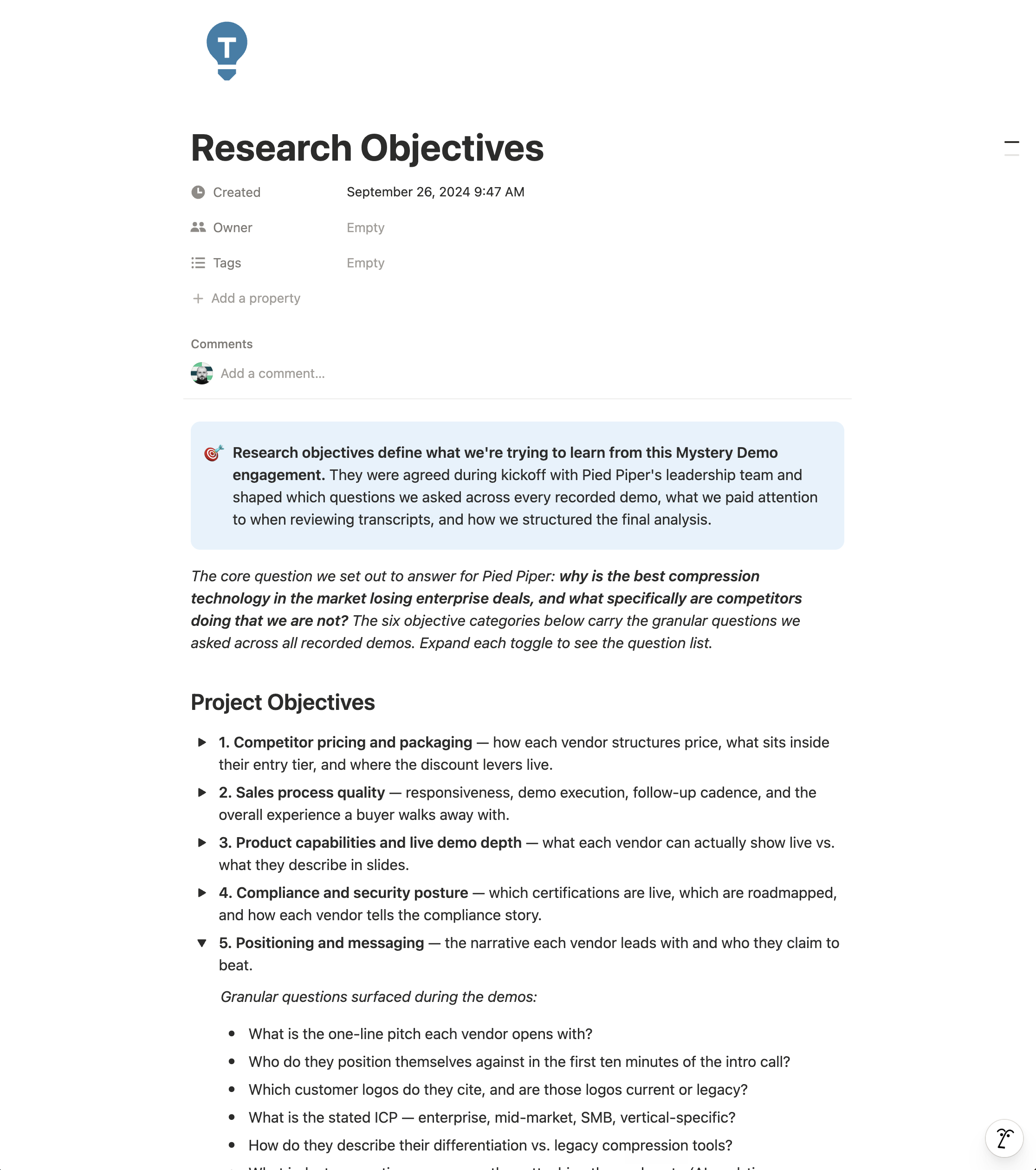
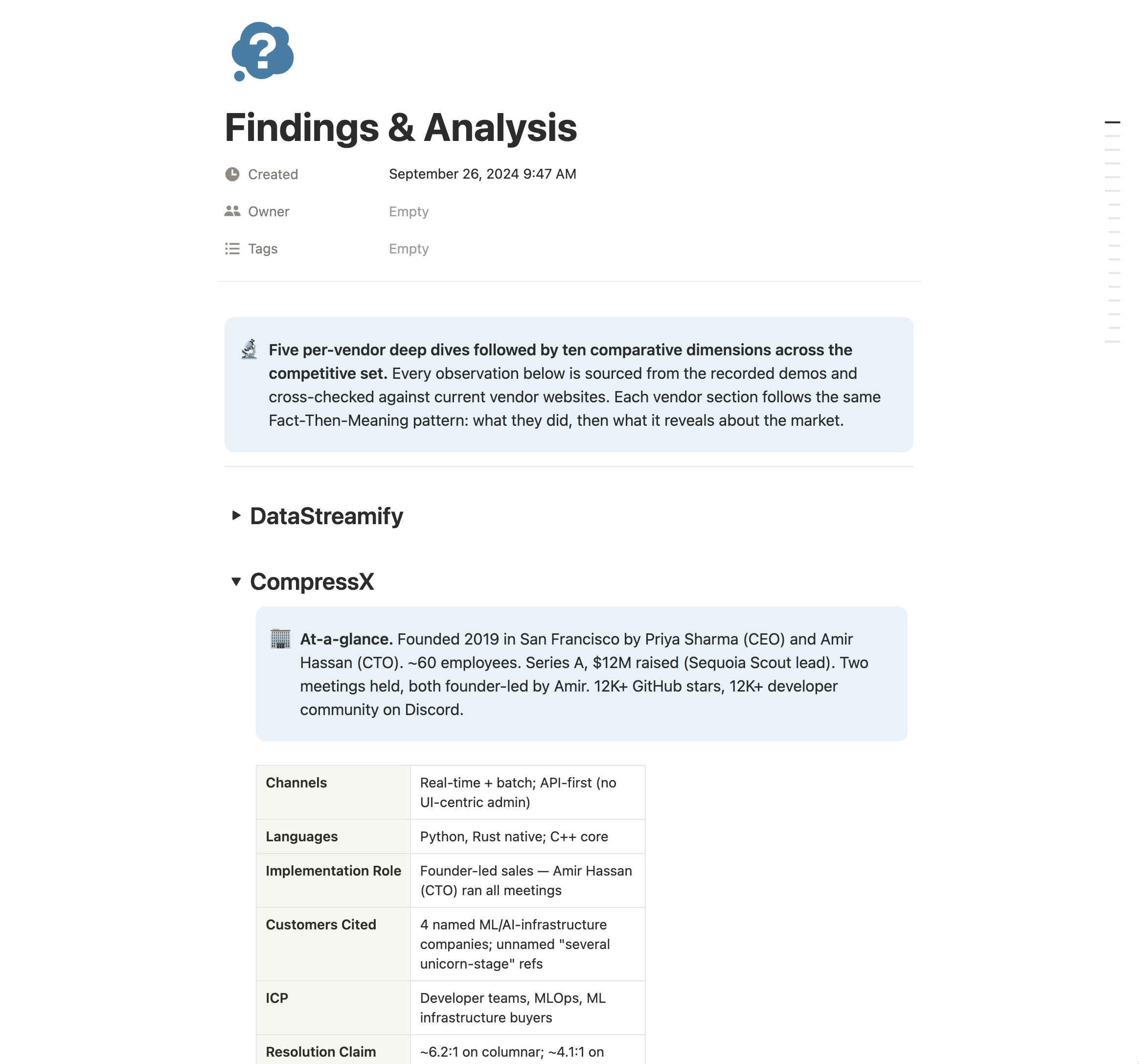
A Mystery Demo market entry research project gives you a complete map of who sells what to whom inside a category. You get pricing bands, ICP segmentation for each competitor, the positioning axes everyone is fighting over, and the sales-motion patterns that repeat across the field. Everything lands in a structured Notion board with recordings, transcripts, and comparison matrices, and it closes with a strategic synthesis that turns the intelligence into where you can credibly win.
A McKinsey or Forrester study describes a category from the outside, built on analyst commentary and secondary sources. Mystery Demo's market entry research describes it from the inside, because we book and attend the live sales cycles of every serious player in the category. You end up with primary-source intelligence on what is genuinely being pitched and bought, captured from inside the demo room rather than summarized from a distance.
Mystery Demo starts from the buyer's side of the table. We look at who shows up on a buyer's shortlist when they research the category, who gets invited to a live demo, and who eventually closes the deal. Then we add the adjacent and emerging players who do not make the shortlist yet but soon might. For most market entry projects, six to ten competitors end up in scope at a fixed EUR 499 per competitor.
Researching a market you have not entered yet is the single best reason to run a Mystery Demo market entry research project. We run the demos as a credible buyer in the new category rather than as your existing brand, so the competitor reps treat us exactly like any other prospect. That means the pricing, positioning, and pitches we capture are precisely what your launch would walk into, giving you the real picture instead of one you have only read about.
Mystery Demo sizes white space by comparing ICP segmentation across every competitor we research, which almost always leaves uncovered seams. You find a buyer profile nobody is targeting well, or a use case that gets lip service on a homepage but never shows up in an actual demo flow. The comparison matrix surfaces those gaps in a way no public market report can, so you enter the market with a thesis grounded in what the field is missing.
Killing a launch is a common and valuable outcome of Mystery Demo's market entry research. A real share of projects end up disconfirming the launch thesis, and that is exactly what the research exists to do. Walking away from a bad launch before you spend a year and a serious burn rate building for it pays for the project on its own, so a disconfirmed thesis still counts as a clear win.
A full Mystery Demo market entry research project runs roughly four to eight weeks for a cohort of six to ten competitors. Booking the demos takes about a week or two, running the sales cycles in parallel takes a few weeks, and the final strategic synthesis takes about a week. A tight, focused cohort lands at the shorter end, since the demos run alongside each other rather than one after another.
Mystery Demo's market entry research covers both, using the same approach. For a new geography, we build a believable buyer profile rooted in that target region, run the cycle against the regional competitors, and capture how pricing, positioning, and sales motion differ from your home market. Geographic expansions tend to surface even more surprises than net-new category entries, which is exactly why entering a market you have only read about is so risky.
Yes. In a build-versus-buy decision, Mystery Demo's market entry research evaluates each buy candidate as a competitor first. We book and run their full sales cycle and capture their positioning, customer base, and pricing, and that same intelligence then feeds the M&A conversation. Acquirers usually learn more about a target from one well-run sales cycle than from a stack of investor decks, because they see how the company really sells.
You should run a Mystery Demo market entry research project earlier than feels comfortable. Most teams commission it after their strategy group has formed a thesis but before they commit to the build. At that point the research either reinforces the thesis with hard primary-source evidence or kills it before the burn rate starts climbing, so you enter the market with the right thesis instead of an untested hunch.
A Mystery Demo market entry research project gives you a complete map of who sells what to whom inside a category. You get pricing bands, ICP segmentation for each competitor, the positioning axes everyone is fighting over, and the sales-motion patterns that repeat across the field. Everything lands in a structured Notion board with recordings, transcripts, and comparison matrices, and it closes with a strategic synthesis that turns the intelligence into where you can credibly win.
A McKinsey or Forrester study describes a category from the outside, built on analyst commentary and secondary sources. Mystery Demo's market entry research describes it from the inside, because we book and attend the live sales cycles of every serious player in the category. You end up with primary-source intelligence on what is genuinely being pitched and bought, captured from inside the demo room rather than summarized from a distance.
Mystery Demo starts from the buyer's side of the table. We look at who shows up on a buyer's shortlist when they research the category, who gets invited to a live demo, and who eventually closes the deal. Then we add the adjacent and emerging players who do not make the shortlist yet but soon might. For most market entry projects, six to ten competitors end up in scope at a fixed EUR 499 per competitor.
Researching a market you have not entered yet is the single best reason to run a Mystery Demo market entry research project. We run the demos as a credible buyer in the new category rather than as your existing brand, so the competitor reps treat us exactly like any other prospect. That means the pricing, positioning, and pitches we capture are precisely what your launch would walk into, giving you the real picture instead of one you have only read about.
Mystery Demo sizes white space by comparing ICP segmentation across every competitor we research, which almost always leaves uncovered seams. You find a buyer profile nobody is targeting well, or a use case that gets lip service on a homepage but never shows up in an actual demo flow. The comparison matrix surfaces those gaps in a way no public market report can, so you enter the market with a thesis grounded in what the field is missing.
Killing a launch is a common and valuable outcome of Mystery Demo's market entry research. A real share of projects end up disconfirming the launch thesis, and that is exactly what the research exists to do. Walking away from a bad launch before you spend a year and a serious burn rate building for it pays for the project on its own, so a disconfirmed thesis still counts as a clear win.
A full Mystery Demo market entry research project runs roughly four to eight weeks for a cohort of six to ten competitors. Booking the demos takes about a week or two, running the sales cycles in parallel takes a few weeks, and the final strategic synthesis takes about a week. A tight, focused cohort lands at the shorter end, since the demos run alongside each other rather than one after another.
Mystery Demo's market entry research covers both, using the same approach. For a new geography, we build a believable buyer profile rooted in that target region, run the cycle against the regional competitors, and capture how pricing, positioning, and sales motion differ from your home market. Geographic expansions tend to surface even more surprises than net-new category entries, which is exactly why entering a market you have only read about is so risky.
Yes. In a build-versus-buy decision, Mystery Demo's market entry research evaluates each buy candidate as a competitor first. We book and run their full sales cycle and capture their positioning, customer base, and pricing, and that same intelligence then feeds the M&A conversation. Acquirers usually learn more about a target from one well-run sales cycle than from a stack of investor decks, because they see how the company really sells.
You should run a Mystery Demo market entry research project earlier than feels comfortable. Most teams commission it after their strategy group has formed a thesis but before they commit to the build. At that point the research either reinforces the thesis with hard primary-source evidence or kills it before the burn rate starts climbing, so you enter the market with the right thesis instead of an untested hunch.
A Mystery Demo market entry research project gives you a complete map of who sells what to whom inside a category. You get pricing bands, ICP segmentation for each competitor, the positioning axes everyone is fighting over, and the sales-motion patterns that repeat across the field. Everything lands in a structured Notion board with recordings, transcripts, and comparison matrices, and it closes with a strategic synthesis that turns the intelligence into where you can credibly win.
A McKinsey or Forrester study describes a category from the outside, built on analyst commentary and secondary sources. Mystery Demo's market entry research describes it from the inside, because we book and attend the live sales cycles of every serious player in the category. You end up with primary-source intelligence on what is genuinely being pitched and bought, captured from inside the demo room rather than summarized from a distance.
Mystery Demo starts from the buyer's side of the table. We look at who shows up on a buyer's shortlist when they research the category, who gets invited to a live demo, and who eventually closes the deal. Then we add the adjacent and emerging players who do not make the shortlist yet but soon might. For most market entry projects, six to ten competitors end up in scope at a fixed EUR 499 per competitor.
Researching a market you have not entered yet is the single best reason to run a Mystery Demo market entry research project. We run the demos as a credible buyer in the new category rather than as your existing brand, so the competitor reps treat us exactly like any other prospect. That means the pricing, positioning, and pitches we capture are precisely what your launch would walk into, giving you the real picture instead of one you have only read about.
Mystery Demo sizes white space by comparing ICP segmentation across every competitor we research, which almost always leaves uncovered seams. You find a buyer profile nobody is targeting well, or a use case that gets lip service on a homepage but never shows up in an actual demo flow. The comparison matrix surfaces those gaps in a way no public market report can, so you enter the market with a thesis grounded in what the field is missing.
Killing a launch is a common and valuable outcome of Mystery Demo's market entry research. A real share of projects end up disconfirming the launch thesis, and that is exactly what the research exists to do. Walking away from a bad launch before you spend a year and a serious burn rate building for it pays for the project on its own, so a disconfirmed thesis still counts as a clear win.
A full Mystery Demo market entry research project runs roughly four to eight weeks for a cohort of six to ten competitors. Booking the demos takes about a week or two, running the sales cycles in parallel takes a few weeks, and the final strategic synthesis takes about a week. A tight, focused cohort lands at the shorter end, since the demos run alongside each other rather than one after another.
Mystery Demo's market entry research covers both, using the same approach. For a new geography, we build a believable buyer profile rooted in that target region, run the cycle against the regional competitors, and capture how pricing, positioning, and sales motion differ from your home market. Geographic expansions tend to surface even more surprises than net-new category entries, which is exactly why entering a market you have only read about is so risky.
Yes. In a build-versus-buy decision, Mystery Demo's market entry research evaluates each buy candidate as a competitor first. We book and run their full sales cycle and capture their positioning, customer base, and pricing, and that same intelligence then feeds the M&A conversation. Acquirers usually learn more about a target from one well-run sales cycle than from a stack of investor decks, because they see how the company really sells.
You should run a Mystery Demo market entry research project earlier than feels comfortable. Most teams commission it after their strategy group has formed a thesis but before they commit to the build. At that point the research either reinforces the thesis with hard primary-source evidence or kills it before the burn rate starts climbing, so you enter the market with the right thesis instead of an untested hunch.
A Mystery Demo market entry research project gives you a complete map of who sells what to whom inside a category. You get pricing bands, ICP segmentation for each competitor, the positioning axes everyone is fighting over, and the sales-motion patterns that repeat across the field. Everything lands in a structured Notion board with recordings, transcripts, and comparison matrices, and it closes with a strategic synthesis that turns the intelligence into where you can credibly win.
A McKinsey or Forrester study describes a category from the outside, built on analyst commentary and secondary sources. Mystery Demo's market entry research describes it from the inside, because we book and attend the live sales cycles of every serious player in the category. You end up with primary-source intelligence on what is genuinely being pitched and bought, captured from inside the demo room rather than summarized from a distance.
Mystery Demo starts from the buyer's side of the table. We look at who shows up on a buyer's shortlist when they research the category, who gets invited to a live demo, and who eventually closes the deal. Then we add the adjacent and emerging players who do not make the shortlist yet but soon might. For most market entry projects, six to ten competitors end up in scope at a fixed EUR 499 per competitor.
Researching a market you have not entered yet is the single best reason to run a Mystery Demo market entry research project. We run the demos as a credible buyer in the new category rather than as your existing brand, so the competitor reps treat us exactly like any other prospect. That means the pricing, positioning, and pitches we capture are precisely what your launch would walk into, giving you the real picture instead of one you have only read about.
Mystery Demo sizes white space by comparing ICP segmentation across every competitor we research, which almost always leaves uncovered seams. You find a buyer profile nobody is targeting well, or a use case that gets lip service on a homepage but never shows up in an actual demo flow. The comparison matrix surfaces those gaps in a way no public market report can, so you enter the market with a thesis grounded in what the field is missing.
Killing a launch is a common and valuable outcome of Mystery Demo's market entry research. A real share of projects end up disconfirming the launch thesis, and that is exactly what the research exists to do. Walking away from a bad launch before you spend a year and a serious burn rate building for it pays for the project on its own, so a disconfirmed thesis still counts as a clear win.
A full Mystery Demo market entry research project runs roughly four to eight weeks for a cohort of six to ten competitors. Booking the demos takes about a week or two, running the sales cycles in parallel takes a few weeks, and the final strategic synthesis takes about a week. A tight, focused cohort lands at the shorter end, since the demos run alongside each other rather than one after another.
Mystery Demo's market entry research covers both, using the same approach. For a new geography, we build a believable buyer profile rooted in that target region, run the cycle against the regional competitors, and capture how pricing, positioning, and sales motion differ from your home market. Geographic expansions tend to surface even more surprises than net-new category entries, which is exactly why entering a market you have only read about is so risky.
Yes. In a build-versus-buy decision, Mystery Demo's market entry research evaluates each buy candidate as a competitor first. We book and run their full sales cycle and capture their positioning, customer base, and pricing, and that same intelligence then feeds the M&A conversation. Acquirers usually learn more about a target from one well-run sales cycle than from a stack of investor decks, because they see how the company really sells.
You should run a Mystery Demo market entry research project earlier than feels comfortable. Most teams commission it after their strategy group has formed a thesis but before they commit to the build. At that point the research either reinforces the thesis with hard primary-source evidence or kills it before the burn rate starts climbing, so you enter the market with the right thesis instead of an untested hunch.