.png)


A homepage is the sanitized version of the story. Mystery Demo books a live demo with a competitor and captures the narrative their reps lead with: how they frame the category, who they say they beat and why, where they admit weakness once a buyer pushes, and the comparative attacks they make against named rivals. None of that lives on a marketing page, and surfacing that gap is exactly what a competitor messaging comparison does.
Marketing writes the homepage, but reps live in the deal, and the two rarely match word for word. Reps drift toward the framings that close, so the language on a real call is sharper and more revealing than anything published. Mystery Demo records those live demos and lines them up against the public messaging, so your competitor messaging comparison shows you the exact gap between what marketing approved and what sellers say when money is on the line.
Yes. Mystery Demo indexes every recording for your brand name and any direct comparison a rep draws against you. If a competitor names you in most of the demos we record and frames you as the loser, that is a real signal worth reacting to. Your competitor messaging comparison hands you the exact quotes and how often they come up, so you can answer the attack with evidence instead of guesswork.
Repositioning usually runs on competitor marketing pages plus internal hunches, which is a thin foundation for a big call. Mystery Demo replaces the hunches with primary-source evidence from live competitor demos. Your team can see the real competitive narrative across the whole field and make sharper decisions on category claim, ICP framing, and where to harden your story, all from a competitor messaging comparison built on what reps said in the room.
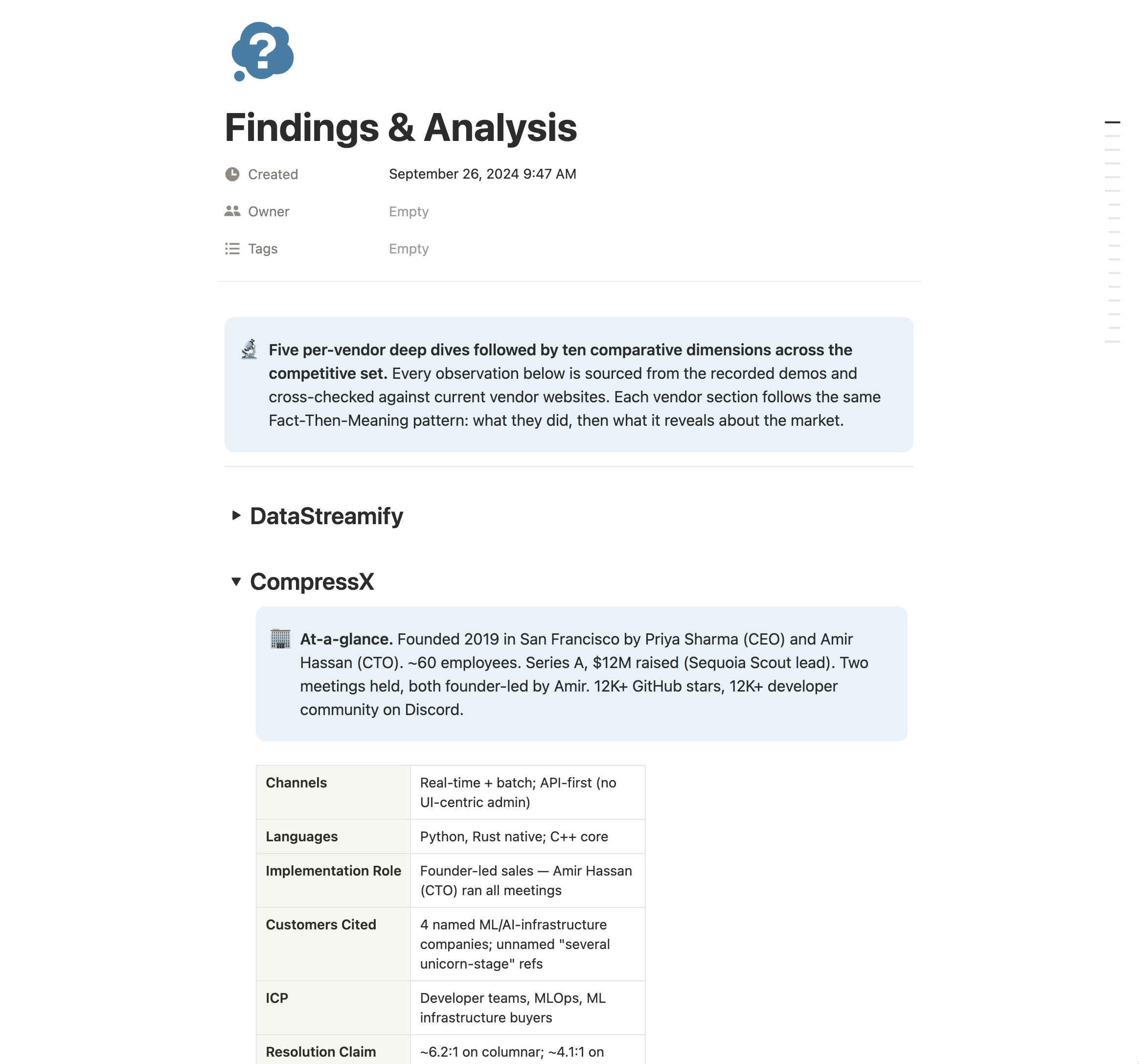
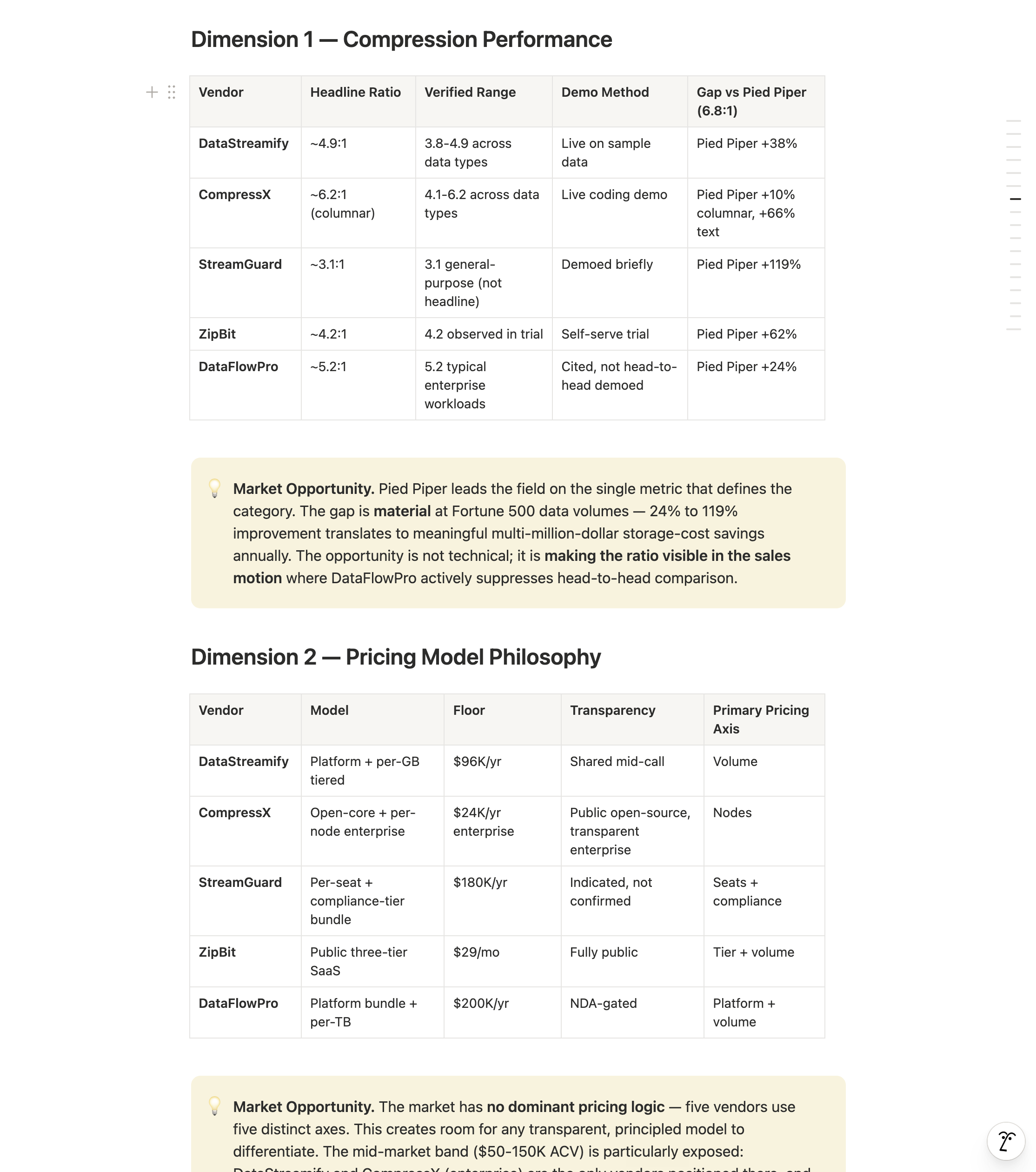
For each competitor you get the demo recording, a transcript with every positioning moment timestamped, and our read on the underlying narrative the rep is selling. Across the full set, Mystery Demo builds the competitor messaging comparison as a messaging matrix that maps the entire positioning landscape, so you can see at a glance where you stand out, where you blend in, and where you are getting attacked. Everything arrives as a structured Notion board.
It is detailed enough to drive ICP decisions directly. Mystery Demo maps how each competitor frames their ideal buyer: who they pitch as the decision maker, which industries they highlight, and which company sizes they chase. Because this comes from how reps pitch the buyer on a live call rather than from a marketing page, your competitor messaging comparison shows where their real targeting differs from their published story, and where competitors disagree on the buyer is the cleanest white space you have.
Yes, and it is one of the best starting points you have. If you are defining a new category or breaking out of an existing one, you first need to know exactly how the entrenched players frame their own category on a live call. Mystery Demo captures that language across competitors and maps it into a competitor messaging comparison, so you can see the framing you have to fight against and the white space you are free to claim.
Messaging moves faster than pricing, so a competitor messaging comparison is worth refreshing whenever a key rival repositions or you are about to make a story decision. Mystery Demo turns around a single-competitor capture in about one to two weeks and a full landscape in roughly four to eight, with demos running in parallel. You can refresh at the cadence your field demands and still ground every call in what sellers said on a live demo.
Yes, and that subtext often tells you more than the explicit pitch. Demo emphasis is positioning, and skipped features are positioning too. Mystery Demo scores the flow of each demo for what the rep highlighted, what they quietly de-emphasized, and what they avoided showing entirely. Those choices go straight into your competitor messaging comparison, because what a seller refuses to demo is a story your competitor is trying hard not to tell.
Yes, and early-stage competitors are often where it pays off most. Their messaging is messier and shifts faster, which is exactly when capturing it matters, because the narrative a rep is testing on calls today predicts the category framing that competitor is likely to lock in as it matures. Mystery Demo captures that live experiment so your competitor messaging comparison reads the move before it hardens into the published story.
A homepage is the sanitized version of the story. Mystery Demo books a live demo with a competitor and captures the narrative their reps lead with: how they frame the category, who they say they beat and why, where they admit weakness once a buyer pushes, and the comparative attacks they make against named rivals. None of that lives on a marketing page, and surfacing that gap is exactly what a competitor messaging comparison does.
Marketing writes the homepage, but reps live in the deal, and the two rarely match word for word. Reps drift toward the framings that close, so the language on a real call is sharper and more revealing than anything published. Mystery Demo records those live demos and lines them up against the public messaging, so your competitor messaging comparison shows you the exact gap between what marketing approved and what sellers say when money is on the line.
Yes. Mystery Demo indexes every recording for your brand name and any direct comparison a rep draws against you. If a competitor names you in most of the demos we record and frames you as the loser, that is a real signal worth reacting to. Your competitor messaging comparison hands you the exact quotes and how often they come up, so you can answer the attack with evidence instead of guesswork.
Repositioning usually runs on competitor marketing pages plus internal hunches, which is a thin foundation for a big call. Mystery Demo replaces the hunches with primary-source evidence from live competitor demos. Your team can see the real competitive narrative across the whole field and make sharper decisions on category claim, ICP framing, and where to harden your story, all from a competitor messaging comparison built on what reps said in the room.
For each competitor you get the demo recording, a transcript with every positioning moment timestamped, and our read on the underlying narrative the rep is selling. Across the full set, Mystery Demo builds the competitor messaging comparison as a messaging matrix that maps the entire positioning landscape, so you can see at a glance where you stand out, where you blend in, and where you are getting attacked. Everything arrives as a structured Notion board.
It is detailed enough to drive ICP decisions directly. Mystery Demo maps how each competitor frames their ideal buyer: who they pitch as the decision maker, which industries they highlight, and which company sizes they chase. Because this comes from how reps pitch the buyer on a live call rather than from a marketing page, your competitor messaging comparison shows where their real targeting differs from their published story, and where competitors disagree on the buyer is the cleanest white space you have.
Yes, and it is one of the best starting points you have. If you are defining a new category or breaking out of an existing one, you first need to know exactly how the entrenched players frame their own category on a live call. Mystery Demo captures that language across competitors and maps it into a competitor messaging comparison, so you can see the framing you have to fight against and the white space you are free to claim.
Messaging moves faster than pricing, so a competitor messaging comparison is worth refreshing whenever a key rival repositions or you are about to make a story decision. Mystery Demo turns around a single-competitor capture in about one to two weeks and a full landscape in roughly four to eight, with demos running in parallel. You can refresh at the cadence your field demands and still ground every call in what sellers said on a live demo.
Yes, and that subtext often tells you more than the explicit pitch. Demo emphasis is positioning, and skipped features are positioning too. Mystery Demo scores the flow of each demo for what the rep highlighted, what they quietly de-emphasized, and what they avoided showing entirely. Those choices go straight into your competitor messaging comparison, because what a seller refuses to demo is a story your competitor is trying hard not to tell.
Yes, and early-stage competitors are often where it pays off most. Their messaging is messier and shifts faster, which is exactly when capturing it matters, because the narrative a rep is testing on calls today predicts the category framing that competitor is likely to lock in as it matures. Mystery Demo captures that live experiment so your competitor messaging comparison reads the move before it hardens into the published story.
A homepage is the sanitized version of the story. Mystery Demo books a live demo with a competitor and captures the narrative their reps lead with: how they frame the category, who they say they beat and why, where they admit weakness once a buyer pushes, and the comparative attacks they make against named rivals. None of that lives on a marketing page, and surfacing that gap is exactly what a competitor messaging comparison does.
Marketing writes the homepage, but reps live in the deal, and the two rarely match word for word. Reps drift toward the framings that close, so the language on a real call is sharper and more revealing than anything published. Mystery Demo records those live demos and lines them up against the public messaging, so your competitor messaging comparison shows you the exact gap between what marketing approved and what sellers say when money is on the line.
Yes. Mystery Demo indexes every recording for your brand name and any direct comparison a rep draws against you. If a competitor names you in most of the demos we record and frames you as the loser, that is a real signal worth reacting to. Your competitor messaging comparison hands you the exact quotes and how often they come up, so you can answer the attack with evidence instead of guesswork.
Repositioning usually runs on competitor marketing pages plus internal hunches, which is a thin foundation for a big call. Mystery Demo replaces the hunches with primary-source evidence from live competitor demos. Your team can see the real competitive narrative across the whole field and make sharper decisions on category claim, ICP framing, and where to harden your story, all from a competitor messaging comparison built on what reps said in the room.
For each competitor you get the demo recording, a transcript with every positioning moment timestamped, and our read on the underlying narrative the rep is selling. Across the full set, Mystery Demo builds the competitor messaging comparison as a messaging matrix that maps the entire positioning landscape, so you can see at a glance where you stand out, where you blend in, and where you are getting attacked. Everything arrives as a structured Notion board.
It is detailed enough to drive ICP decisions directly. Mystery Demo maps how each competitor frames their ideal buyer: who they pitch as the decision maker, which industries they highlight, and which company sizes they chase. Because this comes from how reps pitch the buyer on a live call rather than from a marketing page, your competitor messaging comparison shows where their real targeting differs from their published story, and where competitors disagree on the buyer is the cleanest white space you have.
Yes, and it is one of the best starting points you have. If you are defining a new category or breaking out of an existing one, you first need to know exactly how the entrenched players frame their own category on a live call. Mystery Demo captures that language across competitors and maps it into a competitor messaging comparison, so you can see the framing you have to fight against and the white space you are free to claim.
Messaging moves faster than pricing, so a competitor messaging comparison is worth refreshing whenever a key rival repositions or you are about to make a story decision. Mystery Demo turns around a single-competitor capture in about one to two weeks and a full landscape in roughly four to eight, with demos running in parallel. You can refresh at the cadence your field demands and still ground every call in what sellers said on a live demo.
Yes, and that subtext often tells you more than the explicit pitch. Demo emphasis is positioning, and skipped features are positioning too. Mystery Demo scores the flow of each demo for what the rep highlighted, what they quietly de-emphasized, and what they avoided showing entirely. Those choices go straight into your competitor messaging comparison, because what a seller refuses to demo is a story your competitor is trying hard not to tell.
Yes, and early-stage competitors are often where it pays off most. Their messaging is messier and shifts faster, which is exactly when capturing it matters, because the narrative a rep is testing on calls today predicts the category framing that competitor is likely to lock in as it matures. Mystery Demo captures that live experiment so your competitor messaging comparison reads the move before it hardens into the published story.
A homepage is the sanitized version of the story. Mystery Demo books a live demo with a competitor and captures the narrative their reps lead with: how they frame the category, who they say they beat and why, where they admit weakness once a buyer pushes, and the comparative attacks they make against named rivals. None of that lives on a marketing page, and surfacing that gap is exactly what a competitor messaging comparison does.
Marketing writes the homepage, but reps live in the deal, and the two rarely match word for word. Reps drift toward the framings that close, so the language on a real call is sharper and more revealing than anything published. Mystery Demo records those live demos and lines them up against the public messaging, so your competitor messaging comparison shows you the exact gap between what marketing approved and what sellers say when money is on the line.
Yes. Mystery Demo indexes every recording for your brand name and any direct comparison a rep draws against you. If a competitor names you in most of the demos we record and frames you as the loser, that is a real signal worth reacting to. Your competitor messaging comparison hands you the exact quotes and how often they come up, so you can answer the attack with evidence instead of guesswork.
Repositioning usually runs on competitor marketing pages plus internal hunches, which is a thin foundation for a big call. Mystery Demo replaces the hunches with primary-source evidence from live competitor demos. Your team can see the real competitive narrative across the whole field and make sharper decisions on category claim, ICP framing, and where to harden your story, all from a competitor messaging comparison built on what reps said in the room.
For each competitor you get the demo recording, a transcript with every positioning moment timestamped, and our read on the underlying narrative the rep is selling. Across the full set, Mystery Demo builds the competitor messaging comparison as a messaging matrix that maps the entire positioning landscape, so you can see at a glance where you stand out, where you blend in, and where you are getting attacked. Everything arrives as a structured Notion board.
It is detailed enough to drive ICP decisions directly. Mystery Demo maps how each competitor frames their ideal buyer: who they pitch as the decision maker, which industries they highlight, and which company sizes they chase. Because this comes from how reps pitch the buyer on a live call rather than from a marketing page, your competitor messaging comparison shows where their real targeting differs from their published story, and where competitors disagree on the buyer is the cleanest white space you have.
Yes, and it is one of the best starting points you have. If you are defining a new category or breaking out of an existing one, you first need to know exactly how the entrenched players frame their own category on a live call. Mystery Demo captures that language across competitors and maps it into a competitor messaging comparison, so you can see the framing you have to fight against and the white space you are free to claim.
Messaging moves faster than pricing, so a competitor messaging comparison is worth refreshing whenever a key rival repositions or you are about to make a story decision. Mystery Demo turns around a single-competitor capture in about one to two weeks and a full landscape in roughly four to eight, with demos running in parallel. You can refresh at the cadence your field demands and still ground every call in what sellers said on a live demo.
Yes, and that subtext often tells you more than the explicit pitch. Demo emphasis is positioning, and skipped features are positioning too. Mystery Demo scores the flow of each demo for what the rep highlighted, what they quietly de-emphasized, and what they avoided showing entirely. Those choices go straight into your competitor messaging comparison, because what a seller refuses to demo is a story your competitor is trying hard not to tell.
Yes, and early-stage competitors are often where it pays off most. Their messaging is messier and shifts faster, which is exactly when capturing it matters, because the narrative a rep is testing on calls today predicts the category framing that competitor is likely to lock in as it matures. Mystery Demo captures that live experiment so your competitor messaging comparison reads the move before it hardens into the published story.