.png)


Most SaaS competitor battlecards are stitched together from analyst reports, marketing pages, and one tenured rep's memory, and the sales team knows it. They call it a slide of bullet points someone made up, open it once, and never come back. Battlecards built on guesses lose deals. Mystery Demo builds every card from real competitor demo recordings, which is exactly why reps trust them and keep using them in live deals.
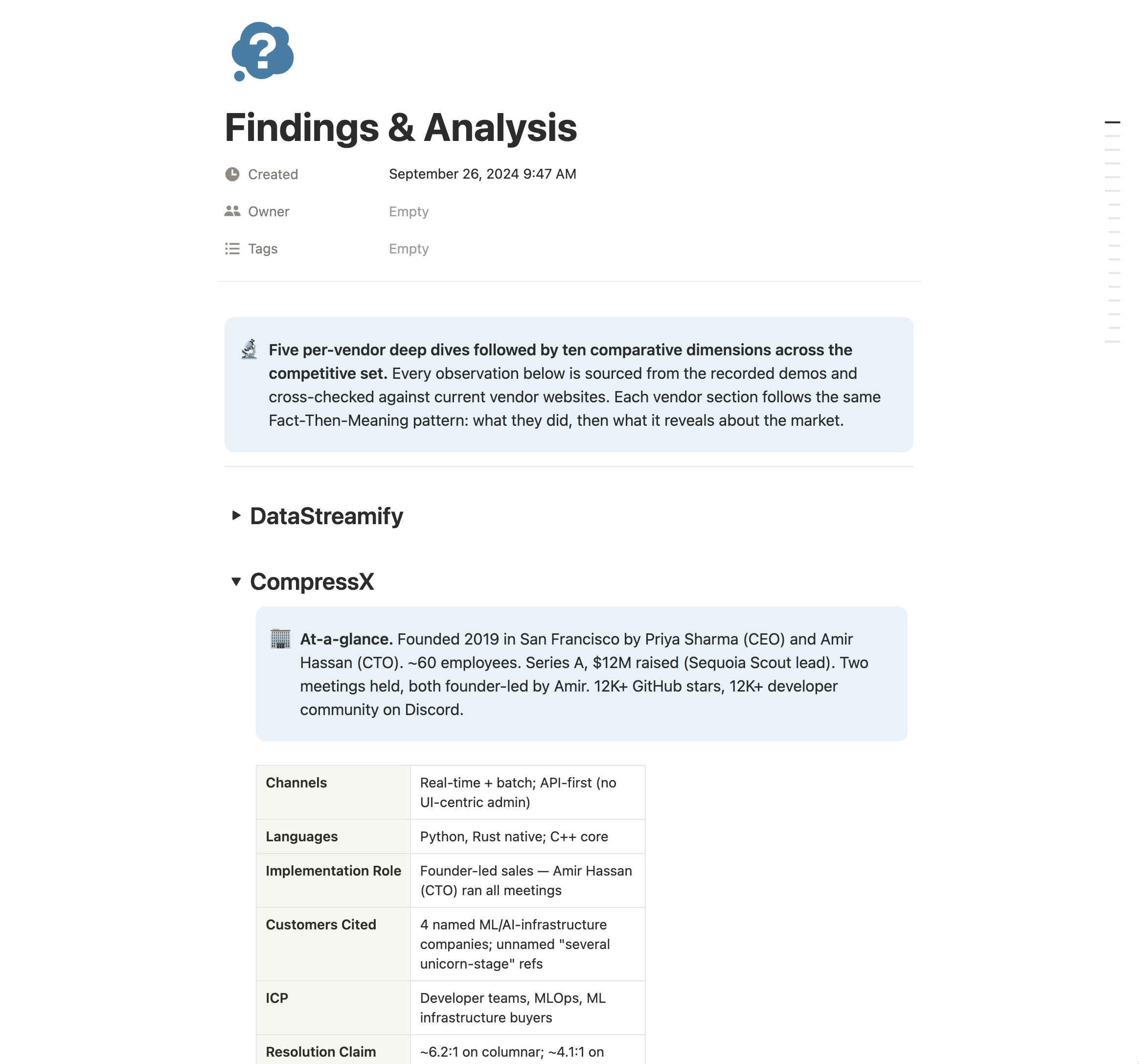
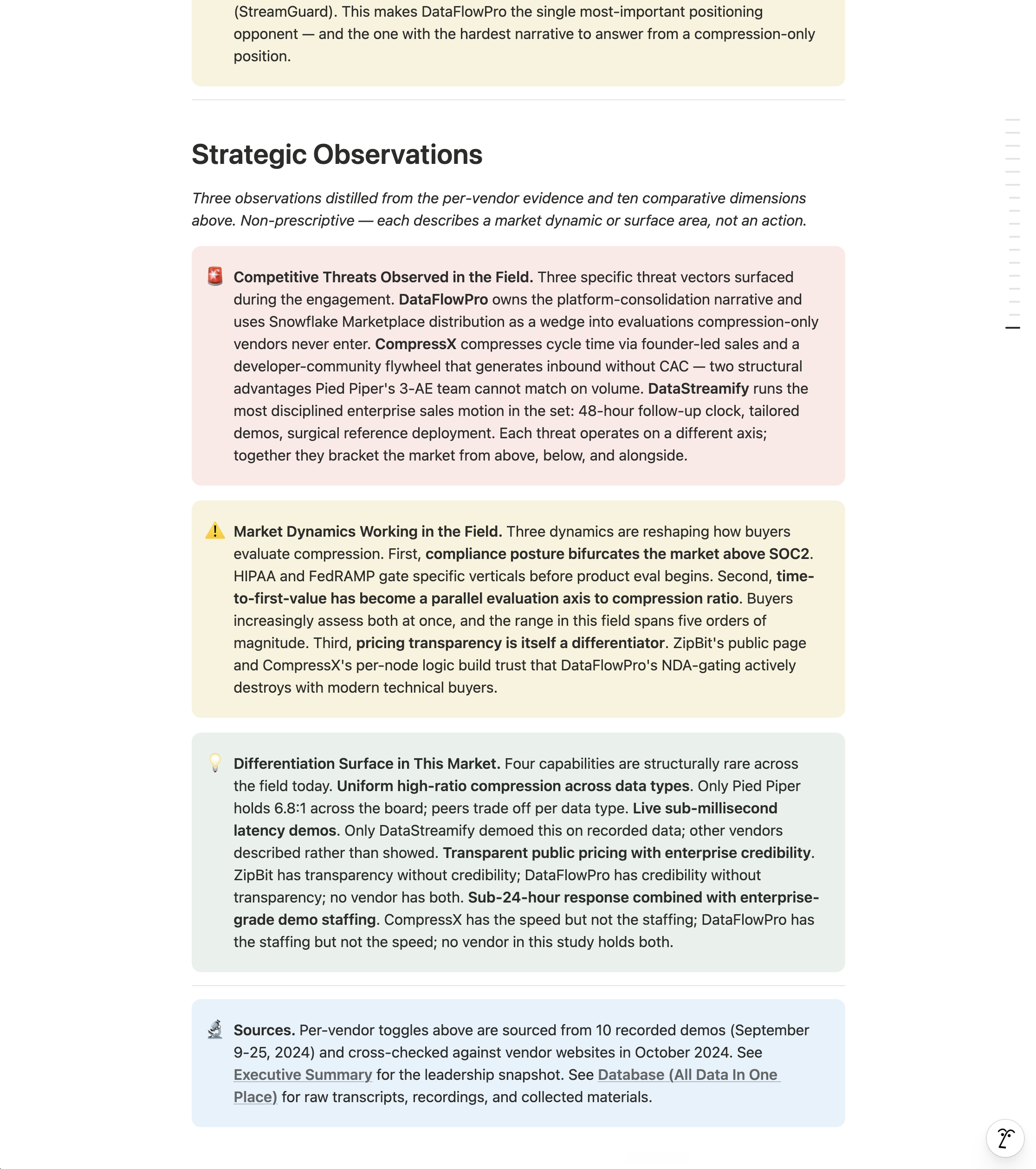
For each competitor, a Mystery Demo SaaS competitor battlecard captures the rep's pitch word for word, the objections they raise about your category, the proof points they deploy, the comparative attacks they make against you, and their pricing approach, along with counter-moves your team can use in a live deal. Every claim is citation-linked to the exact moment in the recording where the competitor said it, so the card is backed by evidence rather than guesses.
A Mystery Demo SaaS competitor battlecard captures list prices, discount thresholds, and the negotiation moves a competitor's rep makes when pushed on cost. Your rep then knows in real time whether the price a prospect is comparing you against is real, inflated, or fully negotiable. Knowing that distinction during a live competitive deal changes how, and at what number, you close. The data comes from real recorded demos, not guesswork.
Yes. Because every claim in your Mystery Demo SaaS competitor battlecard sits in a structured Notion board tied to the exact moment in its source recording, updating is targeted rather than a full rebuild. When a competitor changes its pitch or pricing, you re-run a fresh demo on that one vendor and we recapture only what moved. The card stays sourced and current instead of drifting back into guesses that lose deals.
A Mystery Demo SaaS competitor battlecard lives in the Notion board, ready the moment a prospect names a competitor on a discovery call. The rep opens the matching card, scans the top objections and proof points for that vendor, and walks into the next conversation with the right counters already loaded. A two-minute prep replaces a week of guessing, and the rep wins more competitive deals because every line is sourced from real recordings.
Yes, and that sourcing is the centerpiece of a Mystery Demo SaaS competitor battlecard. Every claim is citation-linked to the exact moment in the recorded demo where the competitor said it, so no line on the card is a guess. When a rep keeps losing to one objection, leadership can trace it straight to the source and coach against what the competitor said on record, rather than against a hunch that costs you deals.
A Mystery Demo SaaS competitor battlecard covers both. The pitch shows you what the competitor sells when they think no one on your side is listening, and the attacks show you exactly what they say about you in a live deal. Most teams discover that the attack surface is larger and more specific than they assumed. Because each line is recording-backed and citation-linked, the card handles every attack with sourced counters instead of guesses.
By default, Mystery Demo builds one SaaS competitor battlecard per competitor, which covers most competitive landscapes. Larger projects sometimes warrant a buyer-persona overlay when a competitor pitches enterprise versus mid-market with materially different framings. In those cases we split the card by persona so each version stays accurate, and every variation is still sourced from real recordings rather than assumptions about how the competitor sells.
They help reps win more competitive deals because every counter on a Mystery Demo SaaS competitor battlecard is sourced, not guessed. The card removes the moments where a rep fumbles an objection it should have prepared them for, since each line is citation-linked to the exact spot in the competitor's recorded demo. Reps walk in ready with the right counters loaded, and more of those head-to-head deals close in your favor.
Yes, and it is one of the most valuable uses of a Mystery Demo SaaS competitor battlecard. A new rep walks into a competitive deal with the same recording-backed cards a senior rep relies on, so the ramp curve flattens dramatically. The institutional knowledge that usually takes a year to build is already sitting in the Notion board on day one, sourced and citation-linked, ready to use in the first week.
Most SaaS competitor battlecards are stitched together from analyst reports, marketing pages, and one tenured rep's memory, and the sales team knows it. They call it a slide of bullet points someone made up, open it once, and never come back. Battlecards built on guesses lose deals. Mystery Demo builds every card from real competitor demo recordings, which is exactly why reps trust them and keep using them in live deals.
For each competitor, a Mystery Demo SaaS competitor battlecard captures the rep's pitch word for word, the objections they raise about your category, the proof points they deploy, the comparative attacks they make against you, and their pricing approach, along with counter-moves your team can use in a live deal. Every claim is citation-linked to the exact moment in the recording where the competitor said it, so the card is backed by evidence rather than guesses.
A Mystery Demo SaaS competitor battlecard captures list prices, discount thresholds, and the negotiation moves a competitor's rep makes when pushed on cost. Your rep then knows in real time whether the price a prospect is comparing you against is real, inflated, or fully negotiable. Knowing that distinction during a live competitive deal changes how, and at what number, you close. The data comes from real recorded demos, not guesswork.
Yes. Because every claim in your Mystery Demo SaaS competitor battlecard sits in a structured Notion board tied to the exact moment in its source recording, updating is targeted rather than a full rebuild. When a competitor changes its pitch or pricing, you re-run a fresh demo on that one vendor and we recapture only what moved. The card stays sourced and current instead of drifting back into guesses that lose deals.
A Mystery Demo SaaS competitor battlecard lives in the Notion board, ready the moment a prospect names a competitor on a discovery call. The rep opens the matching card, scans the top objections and proof points for that vendor, and walks into the next conversation with the right counters already loaded. A two-minute prep replaces a week of guessing, and the rep wins more competitive deals because every line is sourced from real recordings.
Yes, and that sourcing is the centerpiece of a Mystery Demo SaaS competitor battlecard. Every claim is citation-linked to the exact moment in the recorded demo where the competitor said it, so no line on the card is a guess. When a rep keeps losing to one objection, leadership can trace it straight to the source and coach against what the competitor said on record, rather than against a hunch that costs you deals.
A Mystery Demo SaaS competitor battlecard covers both. The pitch shows you what the competitor sells when they think no one on your side is listening, and the attacks show you exactly what they say about you in a live deal. Most teams discover that the attack surface is larger and more specific than they assumed. Because each line is recording-backed and citation-linked, the card handles every attack with sourced counters instead of guesses.
By default, Mystery Demo builds one SaaS competitor battlecard per competitor, which covers most competitive landscapes. Larger projects sometimes warrant a buyer-persona overlay when a competitor pitches enterprise versus mid-market with materially different framings. In those cases we split the card by persona so each version stays accurate, and every variation is still sourced from real recordings rather than assumptions about how the competitor sells.
They help reps win more competitive deals because every counter on a Mystery Demo SaaS competitor battlecard is sourced, not guessed. The card removes the moments where a rep fumbles an objection it should have prepared them for, since each line is citation-linked to the exact spot in the competitor's recorded demo. Reps walk in ready with the right counters loaded, and more of those head-to-head deals close in your favor.
Yes, and it is one of the most valuable uses of a Mystery Demo SaaS competitor battlecard. A new rep walks into a competitive deal with the same recording-backed cards a senior rep relies on, so the ramp curve flattens dramatically. The institutional knowledge that usually takes a year to build is already sitting in the Notion board on day one, sourced and citation-linked, ready to use in the first week.
Most SaaS competitor battlecards are stitched together from analyst reports, marketing pages, and one tenured rep's memory, and the sales team knows it. They call it a slide of bullet points someone made up, open it once, and never come back. Battlecards built on guesses lose deals. Mystery Demo builds every card from real competitor demo recordings, which is exactly why reps trust them and keep using them in live deals.
For each competitor, a Mystery Demo SaaS competitor battlecard captures the rep's pitch word for word, the objections they raise about your category, the proof points they deploy, the comparative attacks they make against you, and their pricing approach, along with counter-moves your team can use in a live deal. Every claim is citation-linked to the exact moment in the recording where the competitor said it, so the card is backed by evidence rather than guesses.
A Mystery Demo SaaS competitor battlecard captures list prices, discount thresholds, and the negotiation moves a competitor's rep makes when pushed on cost. Your rep then knows in real time whether the price a prospect is comparing you against is real, inflated, or fully negotiable. Knowing that distinction during a live competitive deal changes how, and at what number, you close. The data comes from real recorded demos, not guesswork.
Yes. Because every claim in your Mystery Demo SaaS competitor battlecard sits in a structured Notion board tied to the exact moment in its source recording, updating is targeted rather than a full rebuild. When a competitor changes its pitch or pricing, you re-run a fresh demo on that one vendor and we recapture only what moved. The card stays sourced and current instead of drifting back into guesses that lose deals.
A Mystery Demo SaaS competitor battlecard lives in the Notion board, ready the moment a prospect names a competitor on a discovery call. The rep opens the matching card, scans the top objections and proof points for that vendor, and walks into the next conversation with the right counters already loaded. A two-minute prep replaces a week of guessing, and the rep wins more competitive deals because every line is sourced from real recordings.
Yes, and that sourcing is the centerpiece of a Mystery Demo SaaS competitor battlecard. Every claim is citation-linked to the exact moment in the recorded demo where the competitor said it, so no line on the card is a guess. When a rep keeps losing to one objection, leadership can trace it straight to the source and coach against what the competitor said on record, rather than against a hunch that costs you deals.
A Mystery Demo SaaS competitor battlecard covers both. The pitch shows you what the competitor sells when they think no one on your side is listening, and the attacks show you exactly what they say about you in a live deal. Most teams discover that the attack surface is larger and more specific than they assumed. Because each line is recording-backed and citation-linked, the card handles every attack with sourced counters instead of guesses.
By default, Mystery Demo builds one SaaS competitor battlecard per competitor, which covers most competitive landscapes. Larger projects sometimes warrant a buyer-persona overlay when a competitor pitches enterprise versus mid-market with materially different framings. In those cases we split the card by persona so each version stays accurate, and every variation is still sourced from real recordings rather than assumptions about how the competitor sells.
They help reps win more competitive deals because every counter on a Mystery Demo SaaS competitor battlecard is sourced, not guessed. The card removes the moments where a rep fumbles an objection it should have prepared them for, since each line is citation-linked to the exact spot in the competitor's recorded demo. Reps walk in ready with the right counters loaded, and more of those head-to-head deals close in your favor.
Yes, and it is one of the most valuable uses of a Mystery Demo SaaS competitor battlecard. A new rep walks into a competitive deal with the same recording-backed cards a senior rep relies on, so the ramp curve flattens dramatically. The institutional knowledge that usually takes a year to build is already sitting in the Notion board on day one, sourced and citation-linked, ready to use in the first week.
Most SaaS competitor battlecards are stitched together from analyst reports, marketing pages, and one tenured rep's memory, and the sales team knows it. They call it a slide of bullet points someone made up, open it once, and never come back. Battlecards built on guesses lose deals. Mystery Demo builds every card from real competitor demo recordings, which is exactly why reps trust them and keep using them in live deals.
For each competitor, a Mystery Demo SaaS competitor battlecard captures the rep's pitch word for word, the objections they raise about your category, the proof points they deploy, the comparative attacks they make against you, and their pricing approach, along with counter-moves your team can use in a live deal. Every claim is citation-linked to the exact moment in the recording where the competitor said it, so the card is backed by evidence rather than guesses.
A Mystery Demo SaaS competitor battlecard captures list prices, discount thresholds, and the negotiation moves a competitor's rep makes when pushed on cost. Your rep then knows in real time whether the price a prospect is comparing you against is real, inflated, or fully negotiable. Knowing that distinction during a live competitive deal changes how, and at what number, you close. The data comes from real recorded demos, not guesswork.
Yes. Because every claim in your Mystery Demo SaaS competitor battlecard sits in a structured Notion board tied to the exact moment in its source recording, updating is targeted rather than a full rebuild. When a competitor changes its pitch or pricing, you re-run a fresh demo on that one vendor and we recapture only what moved. The card stays sourced and current instead of drifting back into guesses that lose deals.
A Mystery Demo SaaS competitor battlecard lives in the Notion board, ready the moment a prospect names a competitor on a discovery call. The rep opens the matching card, scans the top objections and proof points for that vendor, and walks into the next conversation with the right counters already loaded. A two-minute prep replaces a week of guessing, and the rep wins more competitive deals because every line is sourced from real recordings.
Yes, and that sourcing is the centerpiece of a Mystery Demo SaaS competitor battlecard. Every claim is citation-linked to the exact moment in the recorded demo where the competitor said it, so no line on the card is a guess. When a rep keeps losing to one objection, leadership can trace it straight to the source and coach against what the competitor said on record, rather than against a hunch that costs you deals.
A Mystery Demo SaaS competitor battlecard covers both. The pitch shows you what the competitor sells when they think no one on your side is listening, and the attacks show you exactly what they say about you in a live deal. Most teams discover that the attack surface is larger and more specific than they assumed. Because each line is recording-backed and citation-linked, the card handles every attack with sourced counters instead of guesses.
By default, Mystery Demo builds one SaaS competitor battlecard per competitor, which covers most competitive landscapes. Larger projects sometimes warrant a buyer-persona overlay when a competitor pitches enterprise versus mid-market with materially different framings. In those cases we split the card by persona so each version stays accurate, and every variation is still sourced from real recordings rather than assumptions about how the competitor sells.
They help reps win more competitive deals because every counter on a Mystery Demo SaaS competitor battlecard is sourced, not guessed. The card removes the moments where a rep fumbles an objection it should have prepared them for, since each line is citation-linked to the exact spot in the competitor's recorded demo. Reps walk in ready with the right counters loaded, and more of those head-to-head deals close in your favor.
Yes, and it is one of the most valuable uses of a Mystery Demo SaaS competitor battlecard. A new rep walks into a competitive deal with the same recording-backed cards a senior rep relies on, so the ramp curve flattens dramatically. The institutional knowledge that usually takes a year to build is already sitting in the Notion board on day one, sourced and citation-linked, ready to use in the first week.