.png)


Mystery Demo competitor pricing research captures the numbers a pricing page never shows you. We pull the full tier structure, the list prices, what's bundled into each tier, what's gated behind an upgrade, discount thresholds, contract terms, payment cadence, and any proof-of-concept pricing the rep floats. If a serious buyer could negotiate it, we get it on the record, straight from the live demo and the email follow-up, so you decide with real data.
For SaaS competitor pricing research, a pricing page only shows the list price for the one tier a competitor wants you to see, and an analyst report shows whatever that competitor chose to tell the analyst. Mystery Demo gives you the price quoted to a real buyer in a real sales conversation, after the objection handling, after the discount asks, when the rep is trying to close. That working price and the brochure price are rarely the same number.
No, and that record holds across hundreds of live competitor demos across SaaS with zero blown covers. Each Mystery Demo pricing research project runs on a believable backstory rooted in truth, so the rep treats us as a credible buyer who fits their ideal profile. The conversation stays natural, and the pricing we're offered is the pricing they would quote anyone of that profile. That is exactly why the numbers you decide on are real.
That is normal in enterprise SaaS, and Mystery Demo competitor pricing research is built for it. We run multiple touches when we need to, moving from discovery into a technical deep-dive and then a follow-up with procurement-style questions. Custom pricing surfaces when you ask the right questions across the right meetings, and across dozens of completed projects in SaaS verticals, we know exactly which questions pull the real number out and into your Notion board.
It depends on scope. A Mystery Demo competitor pricing research project on a single competitor runs about one to two weeks. A full landscape across several competitors runs roughly four to eight weeks, because booking demos takes time and the real numbers come out over multiple meetings. We then cut the recordings, write the analysis, and build the comparison matrix. Either way, you end with real data to price against, not a published guess.
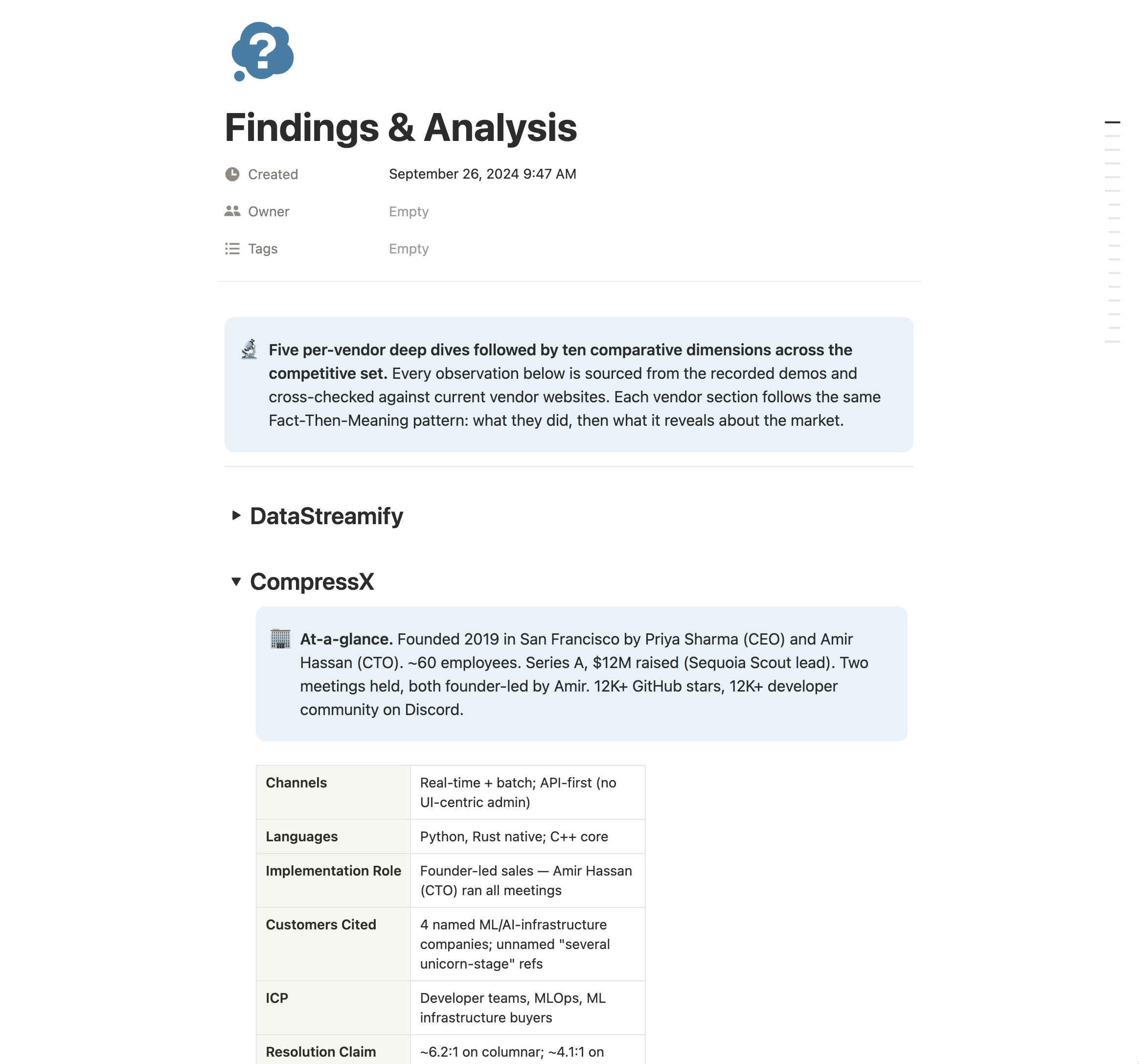
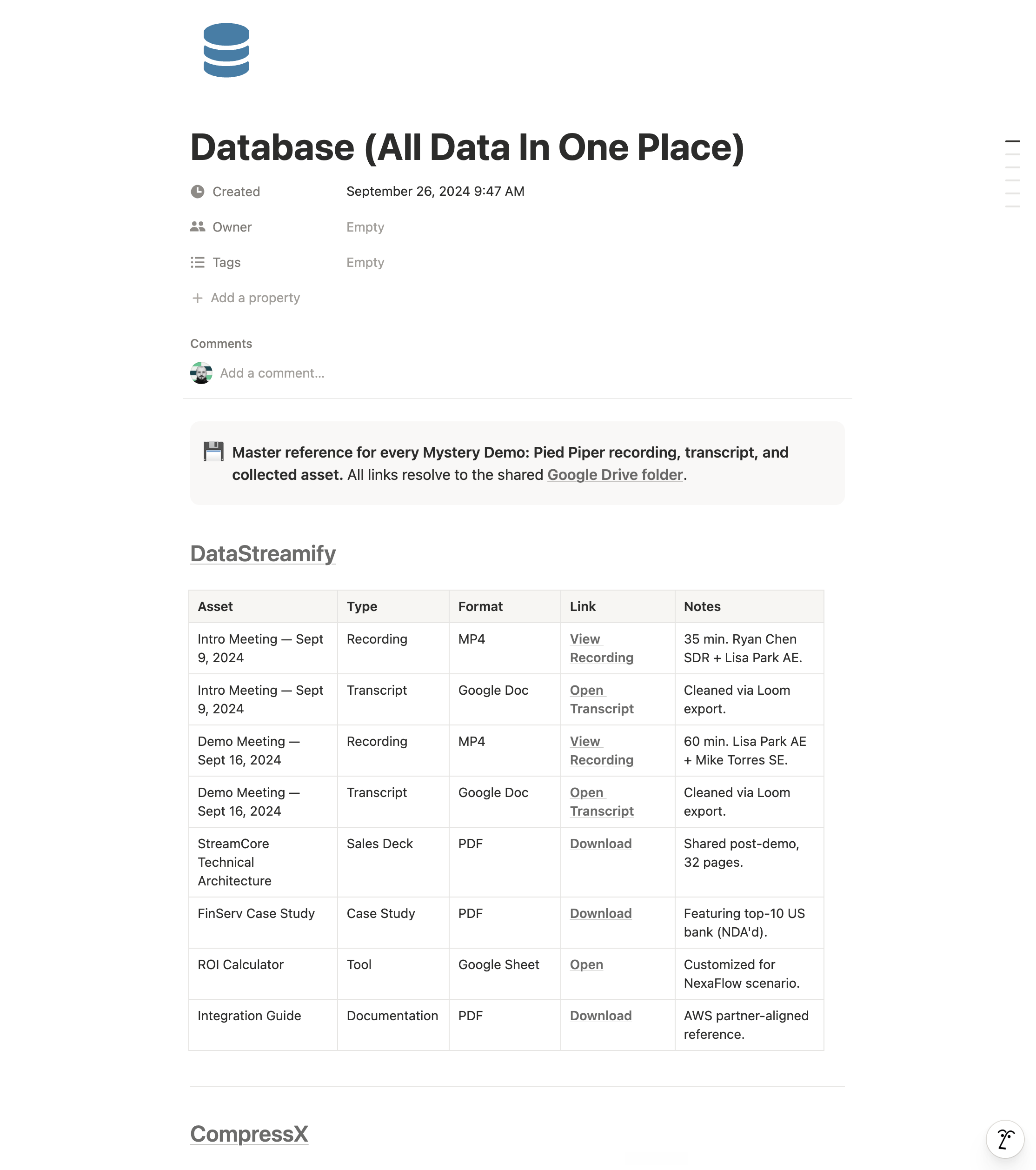
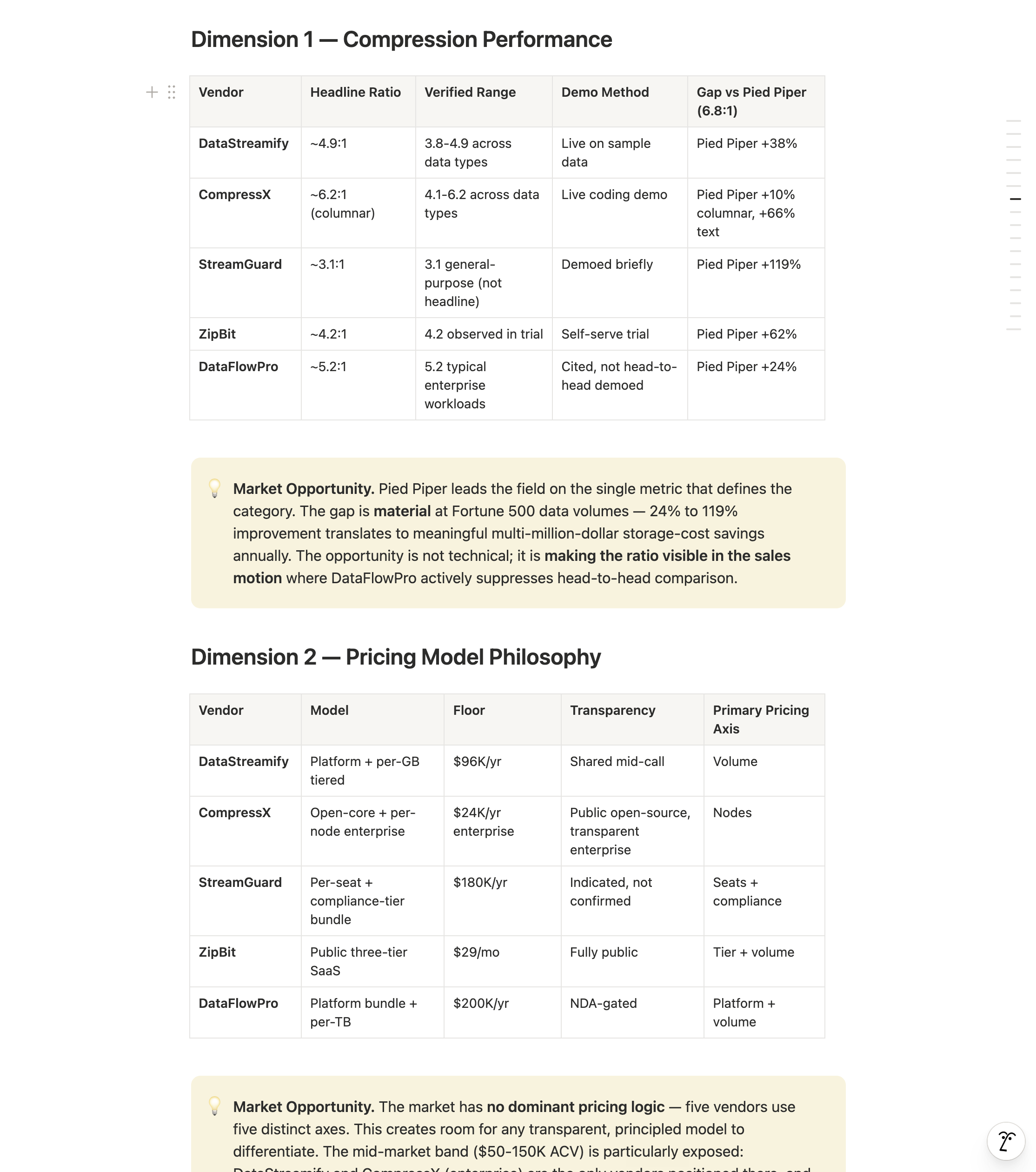
With Mystery Demo competitor pricing research, you get one Notion board per competitor, a fixed EUR 499 each, everything included. Each board holds the demo recording, the AI transcript, every email and PDF the rep sent, our pricing analysis, and a side-by-side matrix mapping tier by tier what each vendor charges. Every number, every quote, lives in one fully hyperlinked place, so your pricing committee can make real decisions without anyone walking them through it.
Yes. For regional competitor pricing research, Mystery Demo adjusts the buyer profile by region, runs the demo with a local-sounding company name and a use case that fits that market, and captures the price quoted to that exact segment. EU pricing often differs from US pricing for the same product, and our comparison matrix puts those numbers side by side so you set your own regional rates on real data instead of guessing at the gap.
Every Mystery Demo competitor pricing research recording is timestamped, so you always know exactly how current each number is. Because we record on our side from the live demo, you are never relying on a stale published page. When a competitor reprices, you can re-run the research on just the vendors that matter and refresh the comparison matrix, which keeps every number accurate enough to make real pricing decisions against with confidence.
Mystery Demo competitor pricing research pays off across four teams at once. The pricing committee works straight from the comparison matrix, product reads how rivals bundle and gate each tier, and sales walks away with the discount thresholds and the negotiation room competitors concede in real deals. The CFO gets a clean read on margin pressure across the category. One project, four downstream uses, all from the same set of real, recorded numbers in one Notion board.
For competitor pricing research, three to five competitors works best when you are driving a focused repricing decision and want depth on each vendor. Six to ten works when you are building a full category map and need broader coverage. Mystery Demo can scale beyond that, but we usually recommend splitting larger sets into cohorts so the pricing analysis stays sharp on every competitor, with every number still landing in one Notion board you can price against.
Mystery Demo competitor pricing research captures the numbers a pricing page never shows you. We pull the full tier structure, the list prices, what's bundled into each tier, what's gated behind an upgrade, discount thresholds, contract terms, payment cadence, and any proof-of-concept pricing the rep floats. If a serious buyer could negotiate it, we get it on the record, straight from the live demo and the email follow-up, so you decide with real data.
For SaaS competitor pricing research, a pricing page only shows the list price for the one tier a competitor wants you to see, and an analyst report shows whatever that competitor chose to tell the analyst. Mystery Demo gives you the price quoted to a real buyer in a real sales conversation, after the objection handling, after the discount asks, when the rep is trying to close. That working price and the brochure price are rarely the same number.
No, and that record holds across hundreds of live competitor demos across SaaS with zero blown covers. Each Mystery Demo pricing research project runs on a believable backstory rooted in truth, so the rep treats us as a credible buyer who fits their ideal profile. The conversation stays natural, and the pricing we're offered is the pricing they would quote anyone of that profile. That is exactly why the numbers you decide on are real.
That is normal in enterprise SaaS, and Mystery Demo competitor pricing research is built for it. We run multiple touches when we need to, moving from discovery into a technical deep-dive and then a follow-up with procurement-style questions. Custom pricing surfaces when you ask the right questions across the right meetings, and across dozens of completed projects in SaaS verticals, we know exactly which questions pull the real number out and into your Notion board.
It depends on scope. A Mystery Demo competitor pricing research project on a single competitor runs about one to two weeks. A full landscape across several competitors runs roughly four to eight weeks, because booking demos takes time and the real numbers come out over multiple meetings. We then cut the recordings, write the analysis, and build the comparison matrix. Either way, you end with real data to price against, not a published guess.
With Mystery Demo competitor pricing research, you get one Notion board per competitor, a fixed EUR 499 each, everything included. Each board holds the demo recording, the AI transcript, every email and PDF the rep sent, our pricing analysis, and a side-by-side matrix mapping tier by tier what each vendor charges. Every number, every quote, lives in one fully hyperlinked place, so your pricing committee can make real decisions without anyone walking them through it.
Yes. For regional competitor pricing research, Mystery Demo adjusts the buyer profile by region, runs the demo with a local-sounding company name and a use case that fits that market, and captures the price quoted to that exact segment. EU pricing often differs from US pricing for the same product, and our comparison matrix puts those numbers side by side so you set your own regional rates on real data instead of guessing at the gap.
Every Mystery Demo competitor pricing research recording is timestamped, so you always know exactly how current each number is. Because we record on our side from the live demo, you are never relying on a stale published page. When a competitor reprices, you can re-run the research on just the vendors that matter and refresh the comparison matrix, which keeps every number accurate enough to make real pricing decisions against with confidence.
Mystery Demo competitor pricing research pays off across four teams at once. The pricing committee works straight from the comparison matrix, product reads how rivals bundle and gate each tier, and sales walks away with the discount thresholds and the negotiation room competitors concede in real deals. The CFO gets a clean read on margin pressure across the category. One project, four downstream uses, all from the same set of real, recorded numbers in one Notion board.
For competitor pricing research, three to five competitors works best when you are driving a focused repricing decision and want depth on each vendor. Six to ten works when you are building a full category map and need broader coverage. Mystery Demo can scale beyond that, but we usually recommend splitting larger sets into cohorts so the pricing analysis stays sharp on every competitor, with every number still landing in one Notion board you can price against.
Mystery Demo competitor pricing research captures the numbers a pricing page never shows you. We pull the full tier structure, the list prices, what's bundled into each tier, what's gated behind an upgrade, discount thresholds, contract terms, payment cadence, and any proof-of-concept pricing the rep floats. If a serious buyer could negotiate it, we get it on the record, straight from the live demo and the email follow-up, so you decide with real data.
For SaaS competitor pricing research, a pricing page only shows the list price for the one tier a competitor wants you to see, and an analyst report shows whatever that competitor chose to tell the analyst. Mystery Demo gives you the price quoted to a real buyer in a real sales conversation, after the objection handling, after the discount asks, when the rep is trying to close. That working price and the brochure price are rarely the same number.
No, and that record holds across hundreds of live competitor demos across SaaS with zero blown covers. Each Mystery Demo pricing research project runs on a believable backstory rooted in truth, so the rep treats us as a credible buyer who fits their ideal profile. The conversation stays natural, and the pricing we're offered is the pricing they would quote anyone of that profile. That is exactly why the numbers you decide on are real.
That is normal in enterprise SaaS, and Mystery Demo competitor pricing research is built for it. We run multiple touches when we need to, moving from discovery into a technical deep-dive and then a follow-up with procurement-style questions. Custom pricing surfaces when you ask the right questions across the right meetings, and across dozens of completed projects in SaaS verticals, we know exactly which questions pull the real number out and into your Notion board.
It depends on scope. A Mystery Demo competitor pricing research project on a single competitor runs about one to two weeks. A full landscape across several competitors runs roughly four to eight weeks, because booking demos takes time and the real numbers come out over multiple meetings. We then cut the recordings, write the analysis, and build the comparison matrix. Either way, you end with real data to price against, not a published guess.
With Mystery Demo competitor pricing research, you get one Notion board per competitor, a fixed EUR 499 each, everything included. Each board holds the demo recording, the AI transcript, every email and PDF the rep sent, our pricing analysis, and a side-by-side matrix mapping tier by tier what each vendor charges. Every number, every quote, lives in one fully hyperlinked place, so your pricing committee can make real decisions without anyone walking them through it.
Yes. For regional competitor pricing research, Mystery Demo adjusts the buyer profile by region, runs the demo with a local-sounding company name and a use case that fits that market, and captures the price quoted to that exact segment. EU pricing often differs from US pricing for the same product, and our comparison matrix puts those numbers side by side so you set your own regional rates on real data instead of guessing at the gap.
Every Mystery Demo competitor pricing research recording is timestamped, so you always know exactly how current each number is. Because we record on our side from the live demo, you are never relying on a stale published page. When a competitor reprices, you can re-run the research on just the vendors that matter and refresh the comparison matrix, which keeps every number accurate enough to make real pricing decisions against with confidence.
Mystery Demo competitor pricing research pays off across four teams at once. The pricing committee works straight from the comparison matrix, product reads how rivals bundle and gate each tier, and sales walks away with the discount thresholds and the negotiation room competitors concede in real deals. The CFO gets a clean read on margin pressure across the category. One project, four downstream uses, all from the same set of real, recorded numbers in one Notion board.
For competitor pricing research, three to five competitors works best when you are driving a focused repricing decision and want depth on each vendor. Six to ten works when you are building a full category map and need broader coverage. Mystery Demo can scale beyond that, but we usually recommend splitting larger sets into cohorts so the pricing analysis stays sharp on every competitor, with every number still landing in one Notion board you can price against.
Mystery Demo competitor pricing research captures the numbers a pricing page never shows you. We pull the full tier structure, the list prices, what's bundled into each tier, what's gated behind an upgrade, discount thresholds, contract terms, payment cadence, and any proof-of-concept pricing the rep floats. If a serious buyer could negotiate it, we get it on the record, straight from the live demo and the email follow-up, so you decide with real data.
For SaaS competitor pricing research, a pricing page only shows the list price for the one tier a competitor wants you to see, and an analyst report shows whatever that competitor chose to tell the analyst. Mystery Demo gives you the price quoted to a real buyer in a real sales conversation, after the objection handling, after the discount asks, when the rep is trying to close. That working price and the brochure price are rarely the same number.
No, and that record holds across hundreds of live competitor demos across SaaS with zero blown covers. Each Mystery Demo pricing research project runs on a believable backstory rooted in truth, so the rep treats us as a credible buyer who fits their ideal profile. The conversation stays natural, and the pricing we're offered is the pricing they would quote anyone of that profile. That is exactly why the numbers you decide on are real.
That is normal in enterprise SaaS, and Mystery Demo competitor pricing research is built for it. We run multiple touches when we need to, moving from discovery into a technical deep-dive and then a follow-up with procurement-style questions. Custom pricing surfaces when you ask the right questions across the right meetings, and across dozens of completed projects in SaaS verticals, we know exactly which questions pull the real number out and into your Notion board.
It depends on scope. A Mystery Demo competitor pricing research project on a single competitor runs about one to two weeks. A full landscape across several competitors runs roughly four to eight weeks, because booking demos takes time and the real numbers come out over multiple meetings. We then cut the recordings, write the analysis, and build the comparison matrix. Either way, you end with real data to price against, not a published guess.
With Mystery Demo competitor pricing research, you get one Notion board per competitor, a fixed EUR 499 each, everything included. Each board holds the demo recording, the AI transcript, every email and PDF the rep sent, our pricing analysis, and a side-by-side matrix mapping tier by tier what each vendor charges. Every number, every quote, lives in one fully hyperlinked place, so your pricing committee can make real decisions without anyone walking them through it.
Yes. For regional competitor pricing research, Mystery Demo adjusts the buyer profile by region, runs the demo with a local-sounding company name and a use case that fits that market, and captures the price quoted to that exact segment. EU pricing often differs from US pricing for the same product, and our comparison matrix puts those numbers side by side so you set your own regional rates on real data instead of guessing at the gap.
Every Mystery Demo competitor pricing research recording is timestamped, so you always know exactly how current each number is. Because we record on our side from the live demo, you are never relying on a stale published page. When a competitor reprices, you can re-run the research on just the vendors that matter and refresh the comparison matrix, which keeps every number accurate enough to make real pricing decisions against with confidence.
Mystery Demo competitor pricing research pays off across four teams at once. The pricing committee works straight from the comparison matrix, product reads how rivals bundle and gate each tier, and sales walks away with the discount thresholds and the negotiation room competitors concede in real deals. The CFO gets a clean read on margin pressure across the category. One project, four downstream uses, all from the same set of real, recorded numbers in one Notion board.
For competitor pricing research, three to five competitors works best when you are driving a focused repricing decision and want depth on each vendor. Six to ten works when you are building a full category map and need broader coverage. Mystery Demo can scale beyond that, but we usually recommend splitting larger sets into cohorts so the pricing analysis stays sharp on every competitor, with every number still landing in one Notion board you can price against.