
Ask a room full of sales leaders how long a demo should run and you will get a number, said with confidence, that is almost always wrong in both directions.
Half think shorter is always tighter. The other half book a 60-minute slot and fill every minute because the calendar told them to.
We are the buyer on the other end of these calls, on your behalf, with the stopwatch running: when the product finally appears, how long the rep talks before anyone else can, and the exact minute the energy in the room quietly dies.
We collected the most useful, independently verified SaaS demo length statistics we could source, drawn almost entirely from datasets of real, recorded sales calls. Every figure carries a footnote to its original study.
The short version: winning demos run longer because they turn into a conversation. The clock only reports what happened in the room.
If you only keep a handful of these, keep these:
Winning Demos Run 47 Minutes, Losing Ones 36
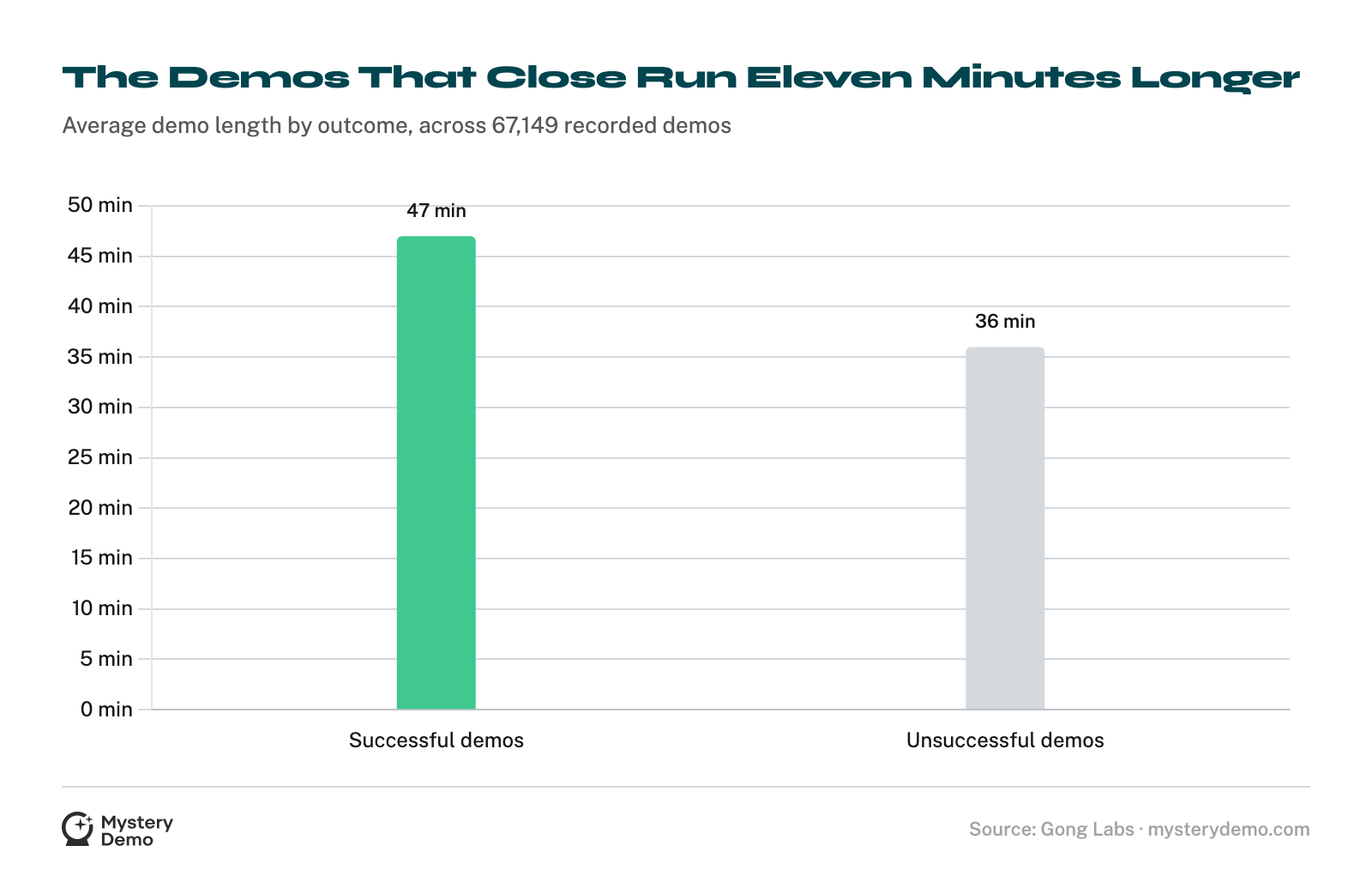
Start with the headline number, because it is the one everyone quotes and almost everyone misreads. In the largest measured study of its kind, successful demos ran 47 minutes against 36 for unsuccessful ones, a 30.5% gap1.
That finding comes from an analysis of 67,149 recorded sales demos matched to real deal outcomes, not a survey of what reps think they do1.
The catch is that the average hides the deal. Demo length scales with what you are buying, so a single benchmark is close to useless without context.
Put the two readings together and the 47-minute figure stops being a target and becomes a clue. A demo that runs long because an enterprise buyer keeps asking is healthy.
A demo that runs long because the rep will not stop talking is the same forty-seven minutes spent badly. The number tells you nothing until you know why the clock moved, which is why we watch the call instead of timing it.
Making a Demo Longer Does Nothing on Its Own
Across 30,000 first calls, there was no statistically significant correlation between how long a call ran and the odds of earning a second meeting4. Tested directly, the relationship falls apart.
The bridge between those two facts is interaction. A demo earns its extra minutes by provoking questions, objections, and tangents from the buyer.
Padding it with more slides earns you nothing but a politely glazed buyer. You cannot fake the length that wins, because it is a side effect of a conversation the buyer wanted to keep having.

The Monologue Is Where Demos Die
A demo dies in the longest stretch where only the rep is talking, and that stretch has a measurable ceiling.
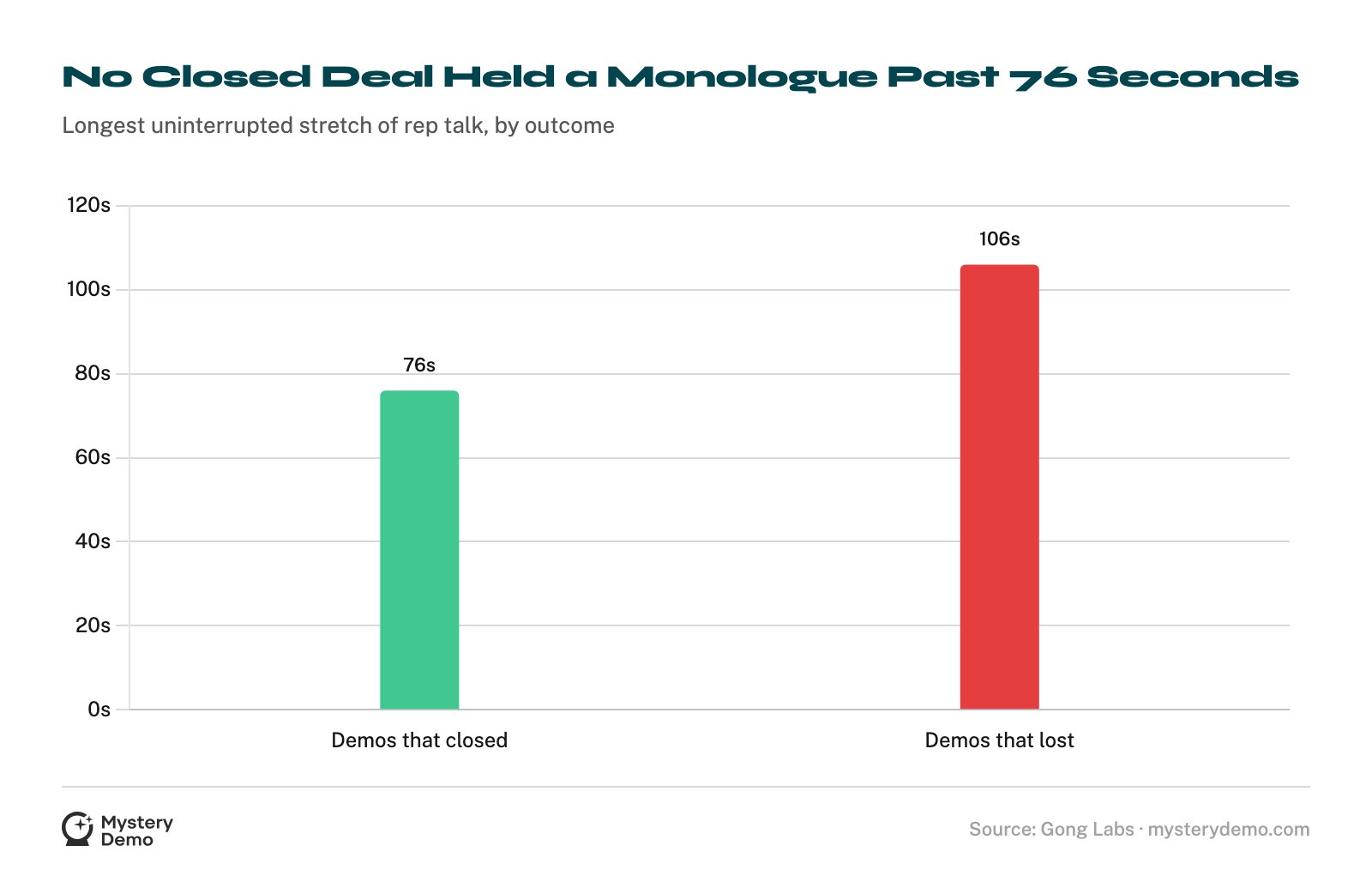
Seventy-six seconds is the entire runway a rep gets before a buyer mentally clocks out.
Timing a rival’s monologues is part of what a competitor sales-tactics review turns up.
The product is the thing the buyer showed up to see. Plenty of reps still make them sit through a company-history slide first, as if anyone books a software demo for the founding story.
The data is blunt about which clock matters: the length of any one stretch where only you are talking. Keep every monologue under a minute and a quarter and the total runtime takes care of itself.
.png)

The Talk Ratio Barely Separates Winners From Losers
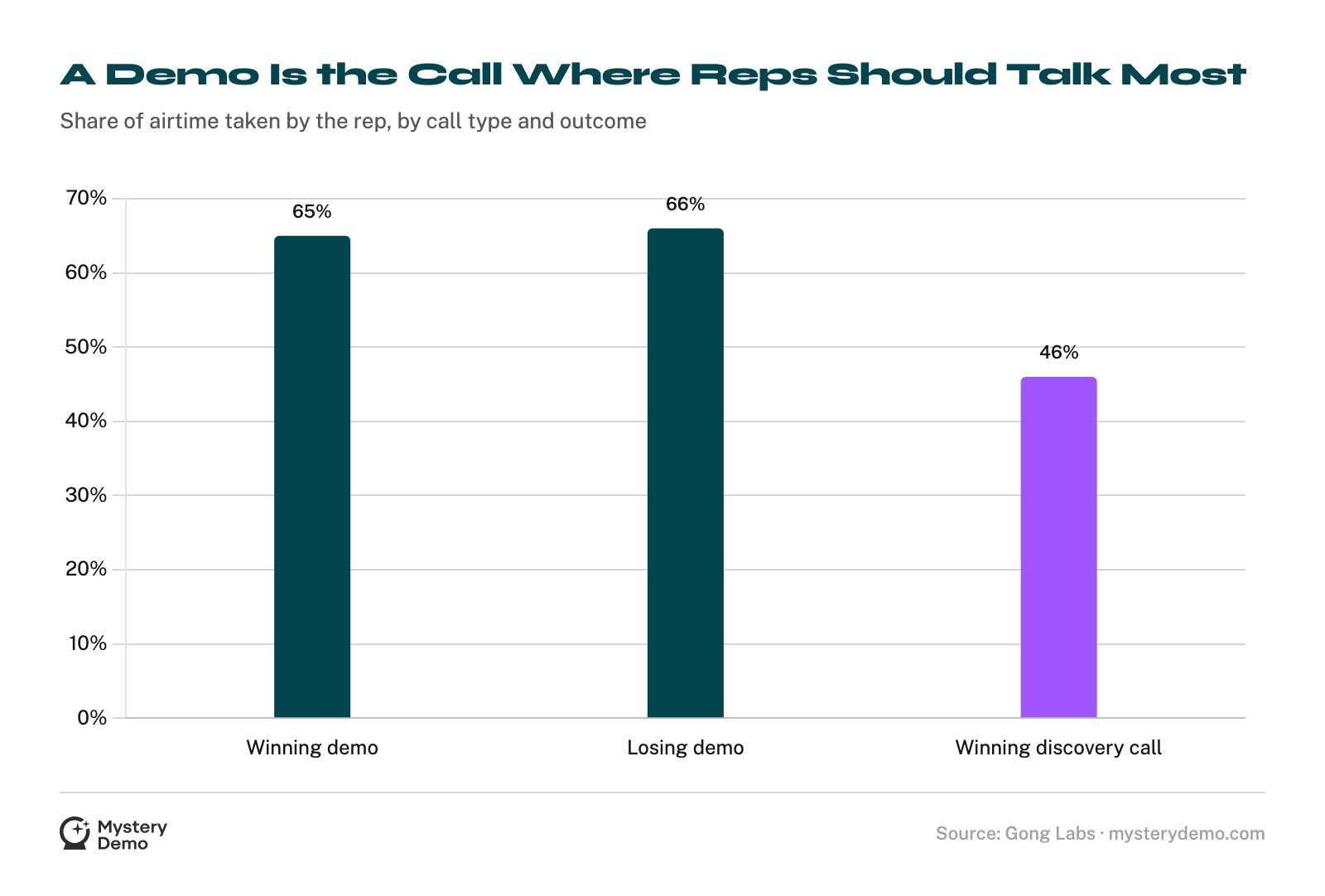
A demo is the one call where the rep is supposed to dominate the airtime, which trips up anyone who memorized the standard advice. The winning talk-to-listen ratio for a demo is 65:35, close to the mirror image of the 46:54 that wins a discovery call1.
Listen too much in a demo and you leave the buyer waiting for the thing they came to see.
Read the ratio alone and you miss the trap underneath it.
Two of those numbers rewrite the usual coaching. The consistency finding says the best reps run the same disciplined process every time, and the buyer’s behavior is what changes around them.
The question finding is more uncomfortable: asking more questions tracked with losing, because past a point, more questions read as an interrogation rather than curiosity.
The skill is making the buyer want to talk.
What that looks like in the recording is movement. Winning demos carry 21% more speaker switches per minute, and that rate climbs another 36% in the second half1. The best reps draw 28% more questions from buyers while asking 30% fewer of their own7.
This is the texture a transcript captures and a stopwatch never will. A demo that gets more interactive as it goes is one the buyer is leaning into.
A demo that flatlines into a steady drone is one they have already left, whatever the invite says. When we grade a competitor’s demo, the speaker-switch rate in the back half tells us more than the runtime ever could.
The Shape of the Call Beats Its Length
A 47-minute winning demo beats a 36-minute loser on where those minutes land, not on the eleven extra ones. The measured shape of a demo that closes is surprisingly consistent.
Read those together and the architecture is clear: get to the product fast, keep the deck short, hold pricing until value is built, then spend real time on what happens next.
The price details cut against instinct. Spending more minutes on price signals a problem rather than thoroughness, because a clean pricing model takes a minute to explain, and the demos that linger on it usually have a confusing model to defend.
The healthiest sign is a buyer who asks three or four sharp pricing questions, gets three or four clean answers, and moves on. Fewer, and the buyer is not engaged enough to buy. More, and something in the pricing is not landing.
All of this is observable from the outside, which is the point. You cannot sit in a rival’s pipeline review, but you can sit in their demo exactly the way their buyers do, and the way a rival paces a demo reads how mature their sales motion really is.
What no benchmark gives you is the competitor in the next tab: which slide they open on, what they refuse to show, and where their reps lose the room.
So how long does your closest rival talk before the product appears? Let’s get us into their next demo, and you will have the answer with a stopwatch on it.
Frequently Asked Questions
How long should a B2B SaaS demo be?
Long enough to solve the buyer’s problem and not a minute longer. In measured data, successful demos averaged 47 minutes versus 36 for unsuccessful ones, though the length follows from the conversation rather than causing it1.
What is the average sales demo length?
Around 47 minutes for demos that close, against 36 minutes for those that do not, based on an analysis of 67,149 recorded demos1.
Does a longer demo win more deals?
Not by itself. Winning demos run longer, yet across 30,000 first calls there was no statistically significant correlation between call duration and advancing the deal4. The length is a side effect of interaction, not a cause of it.
How long should a demo be by company size?
Demo length scales with deal size: roughly 25 to 30 minutes for SMB, 40 to 45 for mid-market, and 45 to 60 for enterprise8.
What is the ideal talk-to-listen ratio in a demo?
About 65:35 in the rep’s favor, close to the reverse of a discovery call, which wins at 46:541. A demo is the one call where the rep is meant to lead the airtime.
Why is the demo talk ratio so different from a discovery call?
Because the jobs differ. Discovery is for listening and diagnosing, so the winning ratio is 46:54; a demo is for showing and explaining, so it flips to 65:351.
How long can a sales rep talk without losing the buyer?
Not long. No demo that closed contained more than 76 seconds of uninterrupted pitching, while losing demos ran monologues up to 106 seconds1.
What happens when a rep talks too long in one stretch?
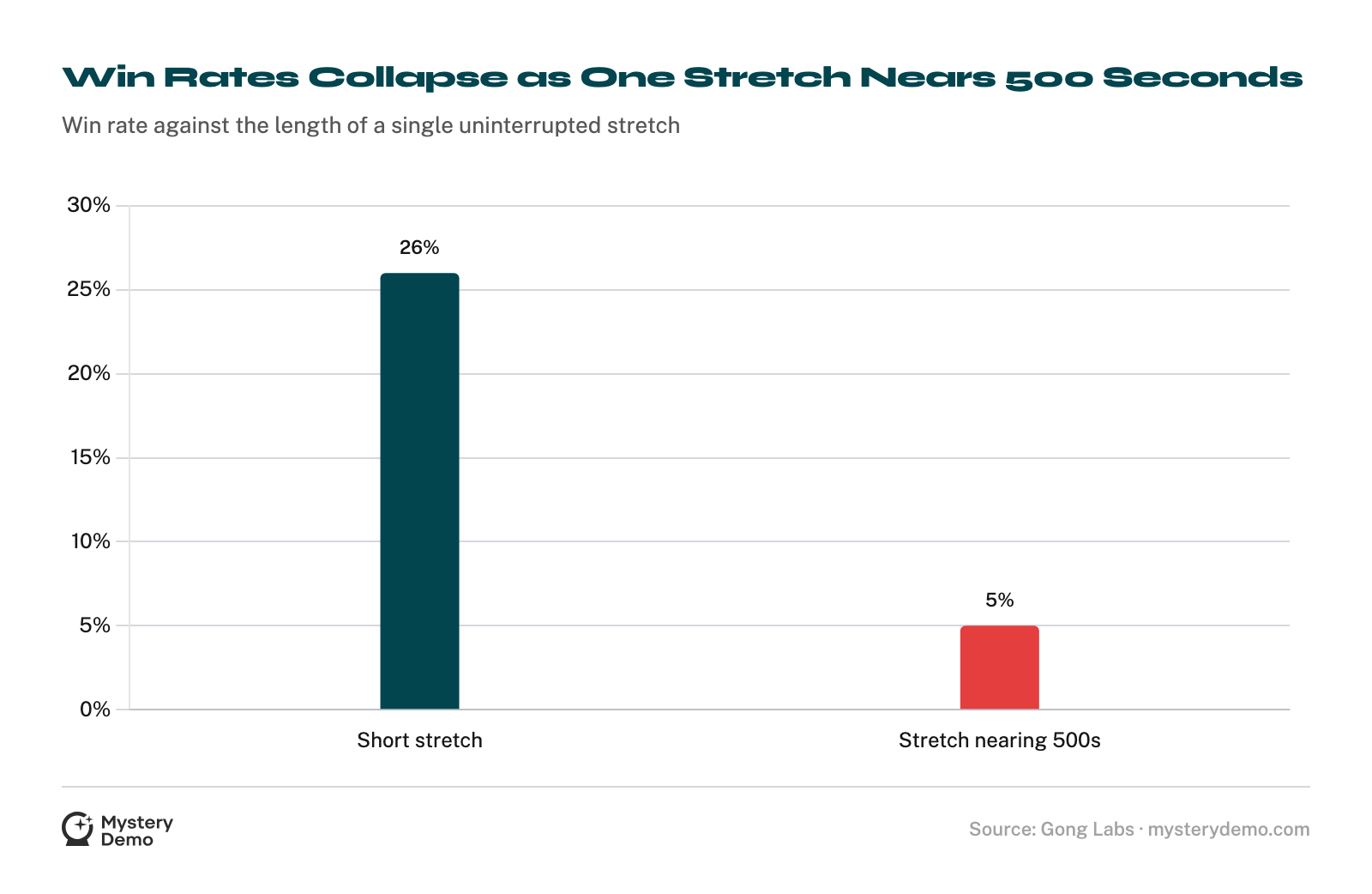
Win rates collapse. As a single uninterrupted stretch grows toward 500 seconds, roughly eight minutes, win rates fall from 26% to 5%3.
How long should a rep spend introducing their company?
Under two minutes. Talking about your own company past the two-minute mark is a cliff, with win rates dropping sharply beyond it5.
How quickly should a demo get to the product?
Fast. In winning demos, the rep sets context for under two minutes before showing the product1.
How long should the slide deck portion of a demo last?
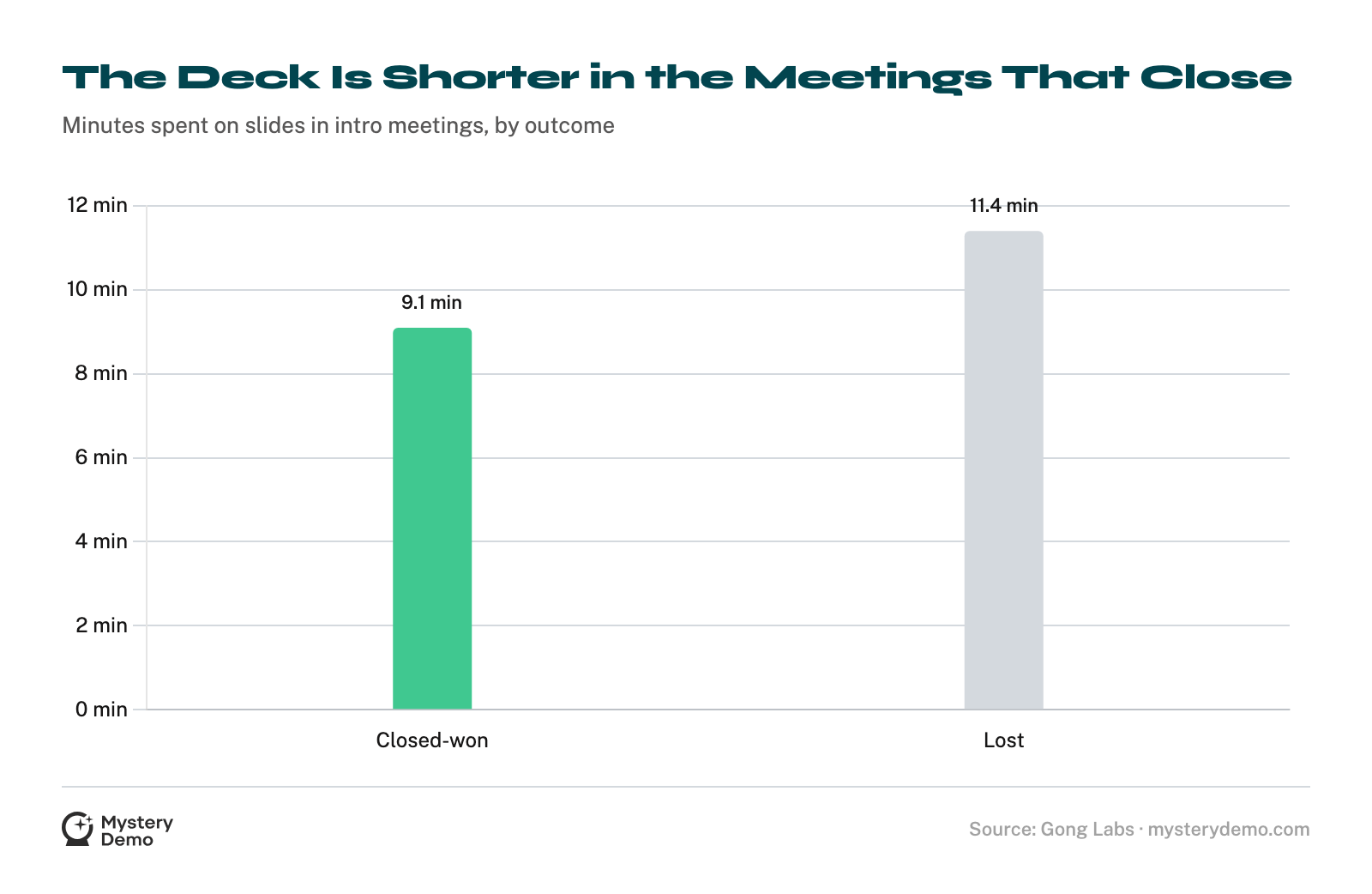
Keep it brief. Intro meetings that became closed-won spent 9.1 minutes on the deck versus 11.4 minutes for losses3.
When should pricing come up in a demo?
Late, after value is built. In winning demos, pricing surfaces between the 38 and 46 minute mark, while losing demos have no consistent window for it1.
Is spending more time on pricing a good sign?
Usually the opposite. Losing demos spend 8% more time talking price, which often signals a confusing pricing model rather than a thorough one1.
How many pricing questions should a buyer ask?
Three to four buyer pricing questions correlate with the highest win rates; fewer or more, and the odds begin to decline6.
How much of a demo should be spent on next steps?
More than most reps think. Winning demos give 12.7% more time to next steps, about four minutes of logistics at the close1.
Do top reps talk less than average reps?
On most calls, yes, but the bigger difference is consistency. Top performers hold the same talk ratio whether they win or lose, while low performers swing from 54% talk in won deals to 64% in lost ones2.
Does asking more questions help in a demo?
Not past a point. Reps who won asked 15 to 16 questions per call, while reps who lost asked more, about 20, where it starts to feel like an interrogation2.
What does an engaged demo look like in the data?
It looks like movement. Winning demos have 21% more speaker switches per minute, and that rate climbs another 36% in the second half1.
What is the current average talk-to-listen ratio across sales calls?
In a 2025 analysis of 326,000 calls, the average was 60% talking to 40% listening, with closed-won reps at 57% and lost-deal reps at 62%2.
How big was the dataset behind these demo findings?
The core figures come from an analysis of 67,149 recorded sales demos matched to deal outcomes, drawn from real recorded calls rather than surveys1.
What does demo length reveal about a competitor?
A great deal. How fast a rival gets to the product, how long their reps can go without a breath, and where they place pricing all signal how mature their sales motion is, which is what we capture for you, minute by minute.
References
- Gong Labs: Effective Strategies for Conducting Successful Sales Demos (2017)
- Gong Labs: Mastering the Talk-to-Listen Ratio in Sales Calls (2025)
- Gong Labs: 30 Mind-Blowing Sales Stats (2021)
- Gong Labs: Determining the Ideal Duration of a First Sales Call (2017)
- Gong Labs: Effective Strategies for Discussing Your Company in Sales (2016)
- Gong Labs: Mastering Winning Sales Conversations (2017)
- Gong Labs: How to Know if Your Sales Demo Is Going Well (2018)
- Demodesk: Sales Demo Analysis Made Simple (2025)
.png)


