
Every demo that happens is what is left after the funnel finishes filtering. By the time a buyer is sitting in front of a sales engineer, they have survived a gauntlet that quietly eliminated almost everyone who started the journey with them. Most of what a demo funnel does is leak.
We spend our days as the lead these percentages describe: qualifying into competitors’ funnels as a real buyer, on your behalf, and logging which steps advance us and which quietly drop us.
We collected the most useful, independently verified SaaS demo conversion rate statistics we could source, from booking platforms, funnel-benchmark datasets, and product-led growth studies. Each one is footnoted to the study it came from.
The short version: the numbers at each stage are smaller than most teams admit, the booking step is the one you can fix without a better product, and the close gets harder the bigger the deal.
If you only keep a handful of these, keep these:
Three Filters Stand Between Visitor and Demo
Before anyone gets to a demo, the funnel has already done most of its filtering, and the survival rate at each step is humbling.
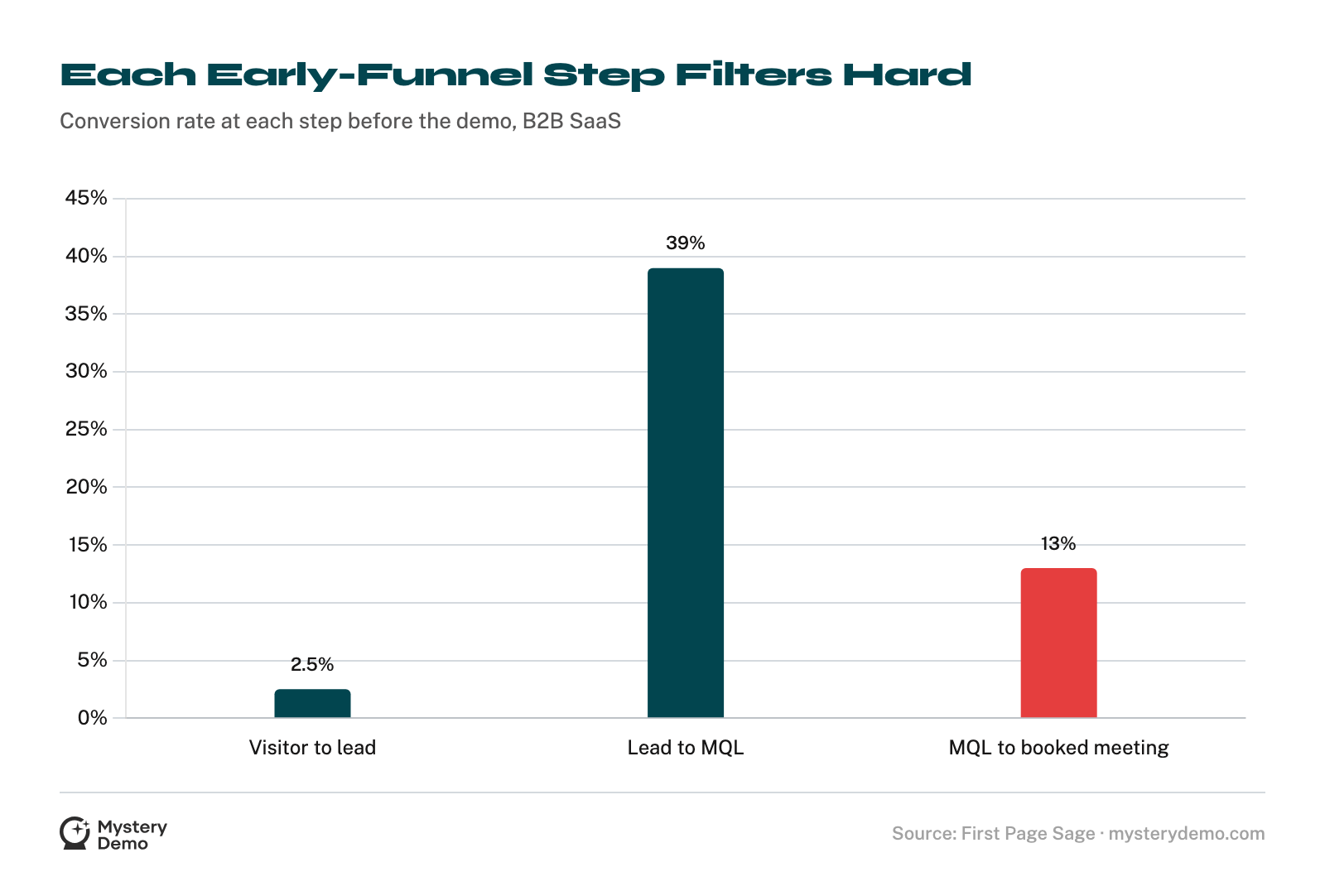
Chain those together and the picture is sobering. Out of a thousand website visitors, about twenty-five become leads, ten of those qualify, and barely more than one ever books a meeting. The demo is the rarest event in the early funnel, not the first one.
The rates read as grim, but the funnel is a filter doing its job: the handful who reach a demo are pre-selected for intent. A booked demo has outlasted every filter ahead of it, which makes it the strongest signal in the pipeline.
Getting the Demo Booked Is the Winnable Part
The one part of this a vendor controls most directly, turning a qualified lead into a booked meeting, is also the one with the most room to move. These are inbound-routing numbers, measured on leads that have already qualified, which is why they sit so far above the industry-wide MQL figures above.
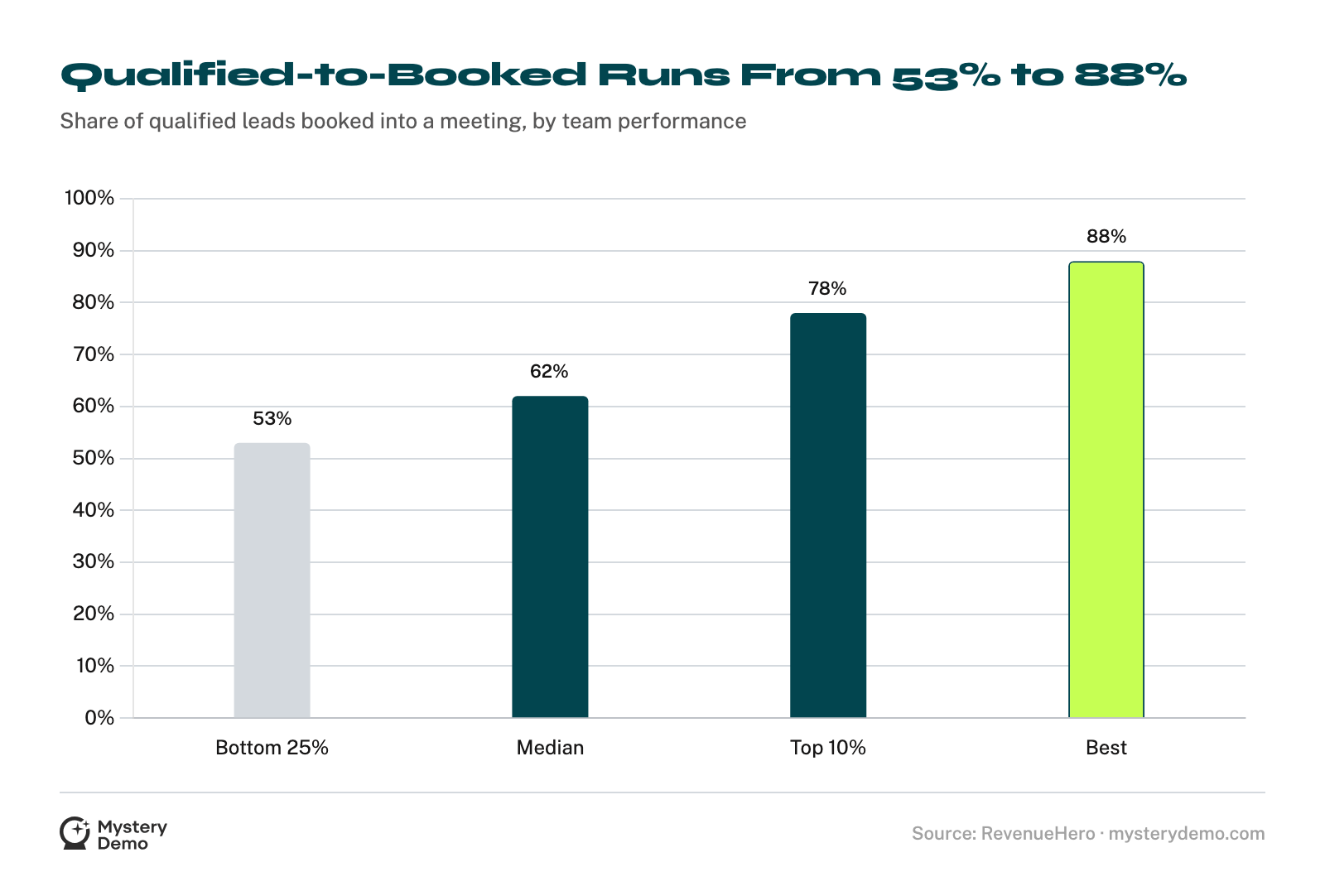
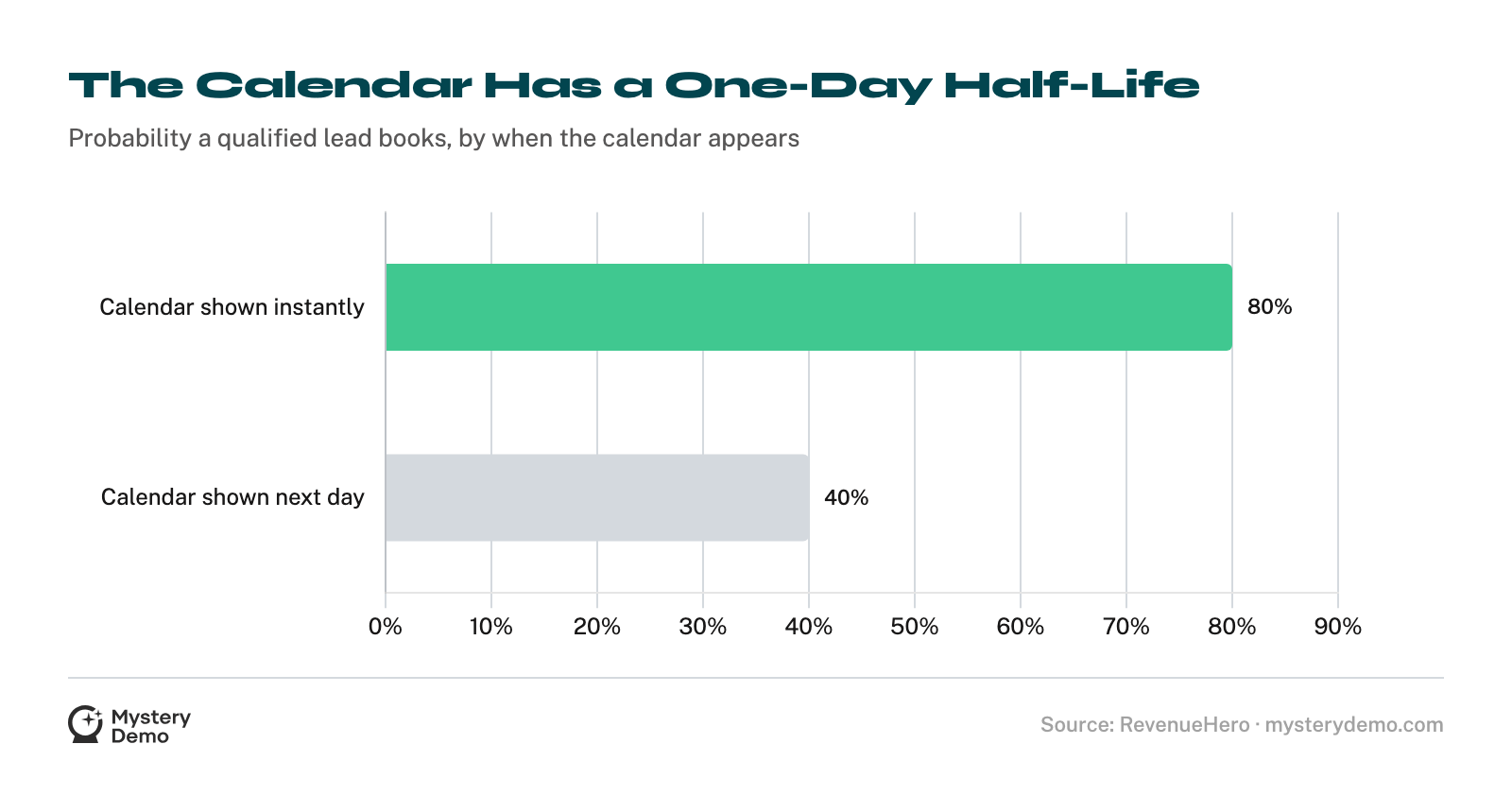
The spread from 53% to 88% on the same kind of traffic comes down to operations: how fast the calendar appears, and how little friction sits between form and slot. A single day of delay cuts booking probability in half.
The enterprise number adds the twist: the teams that book the highest share of qualified leads are also the ones that throw away the most leads upfront. Tighter qualification produces the cleaner booking rate, because the leads that survive the filter are the ones who want the meeting.
Reading a rival’s booking flow this way is part of what a competitor sales-tactics review turns up.
.png)
Most Deals Die After the Demo
The bottom of the funnel has its own arithmetic, and it gets worse the bigger the deal.
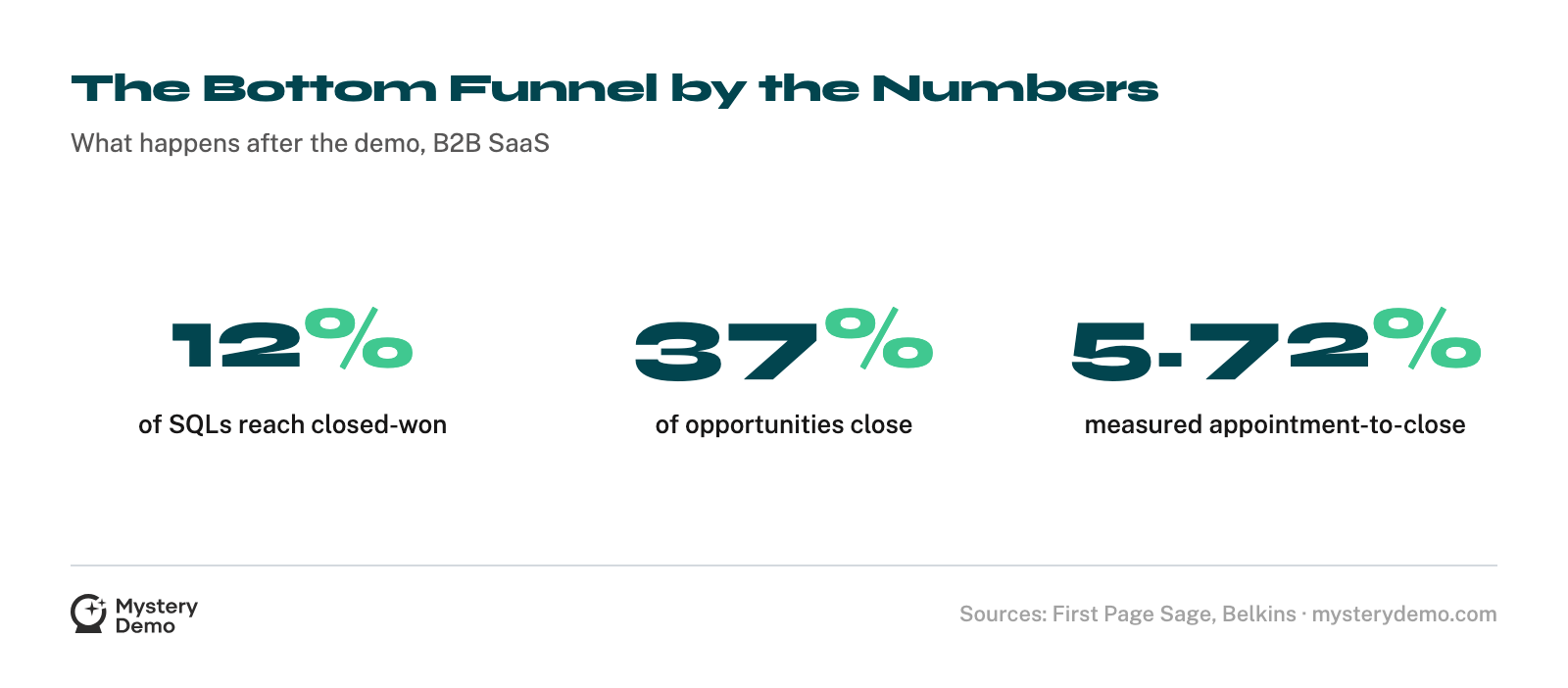
Most teams plan pipeline assuming a demo closes one time in four. The measured rate is closer to one in eight, and that gap changes how much pipeline a team needs.
If only 12% of qualified leads close, the demo mostly confirms fit, and the close still has to be earned later. The segment split is the second story: enterprise opportunities close at 31% against 46% for small business, the price of longer cycles and bigger committees.
Low close rates look like a product problem from a distance. Up close the leaks compound, which is why a team usually gains more from fixing one mid-funnel step than from squeezing the demo itself.

Channel Decides the Math
None of these conversion rates is a single number. They swing wildly depending on where the lead came from, often by more than any optimization inside the funnel could move them.
A client referral qualifies at 56% and an outdoor ad at 14%, which makes the headline benchmark almost useless without the channel mix behind it.
A team with a 39% lead-to-qualified rate built on referrals is in a different position from one hitting the same number on paid traffic, because the referral funnel keeps converting downstream while the paid funnel keeps leaking. When we evaluate how a competitor converts, the first question is where their leads come from.
When the Product Is the Demo
Product-led companies skip the sales call entirely, so the only question that matters is whether a free account starts paying. The numbers there are just as humbling, and just as moveable.
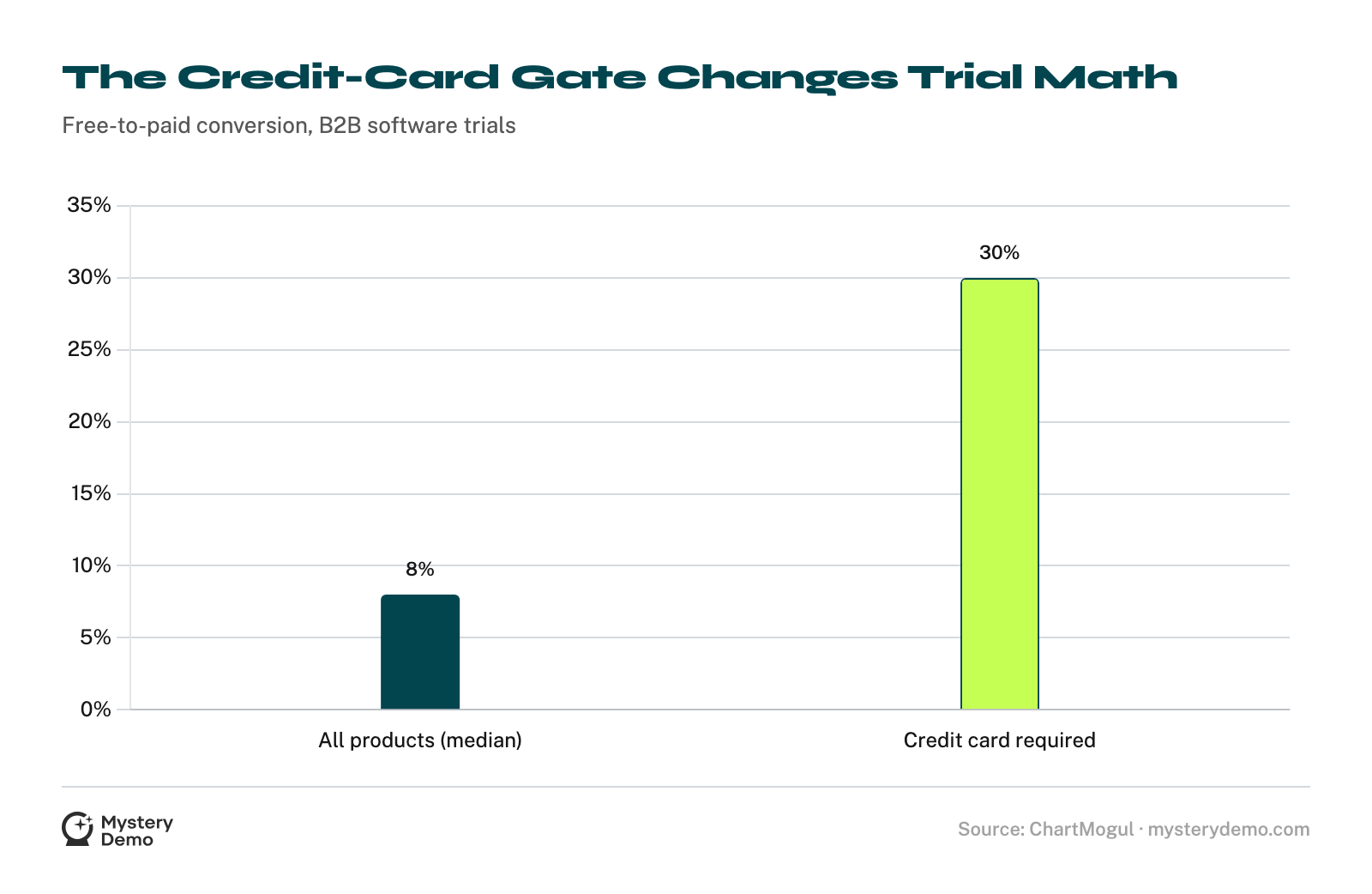
The credit-card finding is the cheapest conversion lever in software: a single form field roughly quintuples free-to-paid, because it pre-qualifies for intent the same way a tight booking filter does.
Conversion is mostly a function of how well you qualify, not how hard you sell. The teams that filter aggressively, through disqualification, a credit-card gate, or a product-usage signal, convert the survivors at far higher rates.
All of this is observable from the outside. From inside a competitor’s funnel, we see where the math holds and where it leaks: how fast they let us book, how hard they qualify, what they gate behind a credit card.
It usually points at deals a rival wins at a step you never see.
That step is invisible from your own dashboard, because it happens inside their funnel. Put us in it, and we will clock every stage from form to booked call and show you which one is costing you the meeting.
Frequently Asked Questions
What is a good demo conversion rate in B2B SaaS?
It depends which step you mean. Among companies running automated inbound routing, the median team books 62% of qualified leads into a meeting1, but only 12% of sales-qualified leads convert to closed-won6.
What percentage of website visitors become leads?
In B2B SaaS, about 2.5%, roughly one in forty visitors7. The figure bundles contact forms, appointment bookings, and demo signups.
What share of leads become marketing-qualified?
Around 31% across all industries and 39% in B2B SaaS5. The rest never clear the first qualification bar.
How many MQLs book a demo?
Few. In B2B SaaS only 13% of marketing-qualified leads make it to a booked or held meeting with a salesperson4.
What is the qualified-lead-to-meeting-booked rate?
In a dataset of companies running automated inbound routing, the median is 62%, with the top 10% at 78%, the best at 88%, and the bottom quarter at 53%1. The wide spread reflects process, not lead quality.
Does instant scheduling improve demo booking rates?
Dramatically. A lead that sees a calendar the moment it qualifies has about an 80% chance of booking; waiting until the next day cuts that to around 40%2.
What is the demo-to-close rate in B2B SaaS?
Lower than folklore suggests. Just 12% of sales-qualified leads close6, and one agency measured a 5.72% appointment-to-close rate across channels11.
What is the opportunity-to-close rate for SaaS?
About 37% of opportunities close, after roughly 49% of SQLs become opportunities3. So even late-stage, most opportunities still fall apart.
Do enterprise deals convert worse than SMB?
At the close, yes. Small-business opportunities close at 46% versus 31% for enterprise3, the cost of longer cycles and larger committees.
How much does lead source affect conversion?
Enormously. Lead-to-qualified runs from 56% for client referrals down to 14% for outdoor advertising5, a four-fold spread by channel alone.
Which channel converts visitors to leads best?
Organic search. SEO converts visitors to leads at 4.1%, more than double the 1.8% from PR and above paid search at 2.7%7.
What is a good free-to-paid conversion rate?
The median across 200 B2B software products is 8%8. Good benchmarks run 3 to 5% for freemium self-serve and 8 to 12% for a free trial9.
Does requiring a credit card improve trial conversion?
By a lot. Free trials that require a credit card convert at 30%, more than five times the rate of trials that do not8.
Do product-qualified leads convert better?
Yes. Free trials that qualify users on product usage convert 2.8x better than those treating every free signup the same10.
Why is the demo conversion rate so low?
Because the funnel compounds. Each stage filters out most of the prior one, so by the time a deal could close, only a single-digit percentage of the original MQLs remain46.
Where in the funnel should you focus to improve conversion?
The booking step and qualification. Booking a qualified lead is the most controllable stage1, and tighter qualification, including instant scheduling and credit-card gates, raises downstream conversion28.
Is a booked demo the same as a lead?
No. A booked demo has already cleared every filter ahead of it, so it carries far more intent than a fresh lead and should be worked accordingly.
What does a competitor’s conversion funnel reveal?
Where they win and leak. How fast they let a buyer book, how hard they qualify, and what they gate all signal how efficient their funnel is, which is what we capture for you, step by step.
References
- RevenueHero: 2025 Inbound Benchmark (2025)
- RevenueHero: Lead-to-Meeting Conversion Benchmarks by Industry in 2026 (2026)
- First Page Sage: B2B SaaS Funnel Conversion Benchmarks (2025)
- First Page Sage: MQL to SQL Conversion Rate by Industry, 2026 Report (2026)
- First Page Sage: Lead-to-MQL Conversion Rate Benchmarks by Industry and Channel (2025)
- First Page Sage: SQL to Closed Won Conversion Rate by Industry, 2026 Report (2026)
- First Page Sage: Website Traffic-to-Lead Conversion Rate, 2026 Report (2026)
- ChartMogul: The Conversion Report, Benchmarks for Trials, Freemium, and Conversion in 2026 (2026)
- Lenny’s Newsletter: What Is a Good Free-to-Paid Conversion (2023)
- Gainsight: Benchmark, Product Qualified Lead Conversion Rates (2022)
- Belkins: B2B Conversion Rates Benchmark (2023)
.png)


