
When a competitor’s name comes up on a sales call, most reps hear a threat to deflect. The data reads it as a pop quiz the buyer has already graded.
By the time the name is spoken, the buyer has usually ranked the field. How early the seller engages that comparison predicts whether the deal closes.
On your behalf, we go through competitors’ funnels as a real buyer, which means we get to say a rival’s name on their call and watch what comes back: the dismissal, the redirect, the nervous discount.
The hard numbers here come almost entirely from the firms that record and measure sales calls, because that is the only place they exist.
We collected the most useful, independently verified SaaS competitor mention statistics on how often competitors come up, when, and what it does to the win rate. Every figure below carries a footnote to the call data behind it.
If you only keep a handful of these, keep these:
The Ranking Is Set Before You Pick Up
6sense asked B2B buyers a narrow question: did you put your shortlist in order before you talked to anyone? The answer, and what those buyers did next, is the whole competitive game in two numbers.
94% of buying groups rank their shortlist in order of preference before they contact any seller6, and among those who ranked, 84% went on to buy from the first vendor they spoke with6.
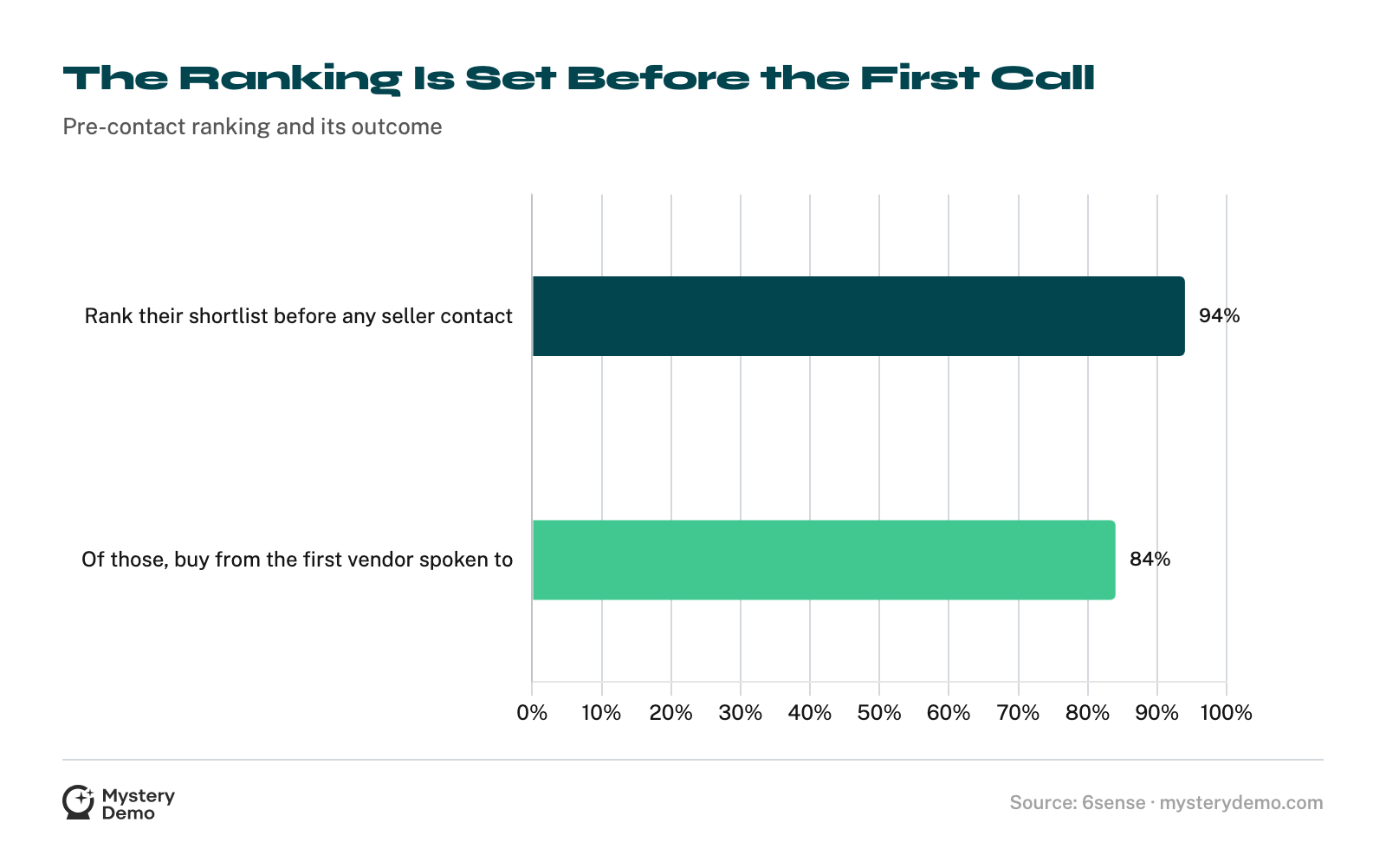
So when a buyer says a rival’s name on your call, they are reading from a list they wrote before you answered the phone. The mention is a status report on a race that is mostly run.
Your job on the call is to find out where you sit on that list, and whether there is still time to move.
Raise the Competitor Early and You Win More
Three cuts of Gong’s call data, taken years apart, all point the same direction on timing.
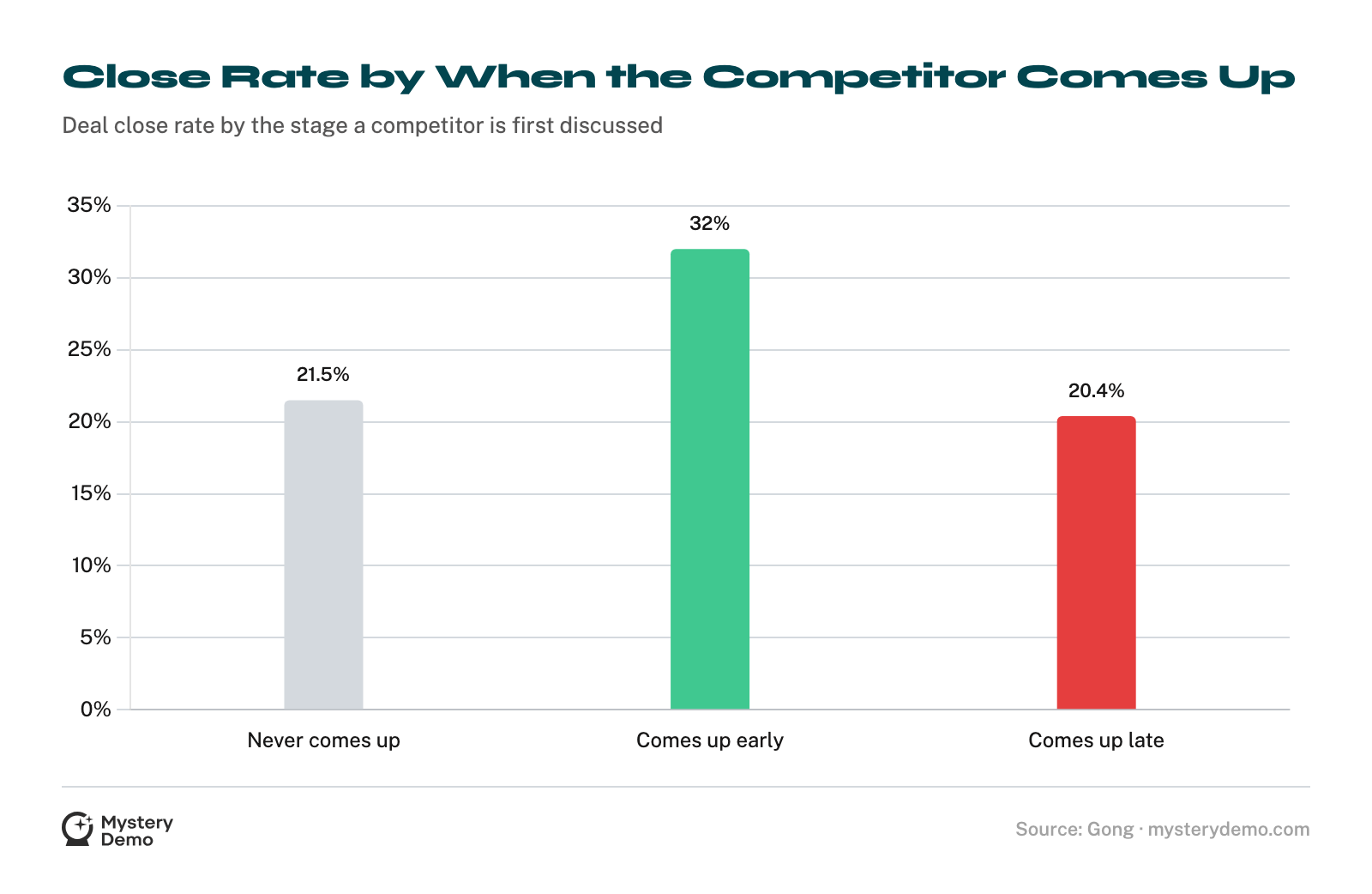
The instinct to change the subject when a competitor comes up is backwards. An early mention means the buyer is engaged enough to be comparing seriously, and the seller who leans into that comparison closes more.
The 32%-versus-21.5% split is the cleanest version of the lesson. A deal where the competition is named early outperforms a deal where it is politely avoided.
Silence usually means the buyer never cared enough to bring up an alternative.
.png)

Bring It Up Late and You Are Already Discounting
The same mention that helps early does the opposite when it arrives late.
When a competitor comes up only in the late stages, close rates fall to 20.4%, below the 21.5% of deals where one never comes up2. Asked about mid-to-late in the cycle, the competition nudges closing odds slightly below greenfield deals1.
A competitor surfacing in pricing or the final evaluation is a different animal from one raised in discovery. Late, it usually means the buyer is wielding the rival as a bargaining chip, and the seller is defending rather than leading.
Competitor Talk Is Multiplying
The timing effect is not static. Buyers are naming more alternatives every year, and the enterprise cut of the data carries a number of its own.
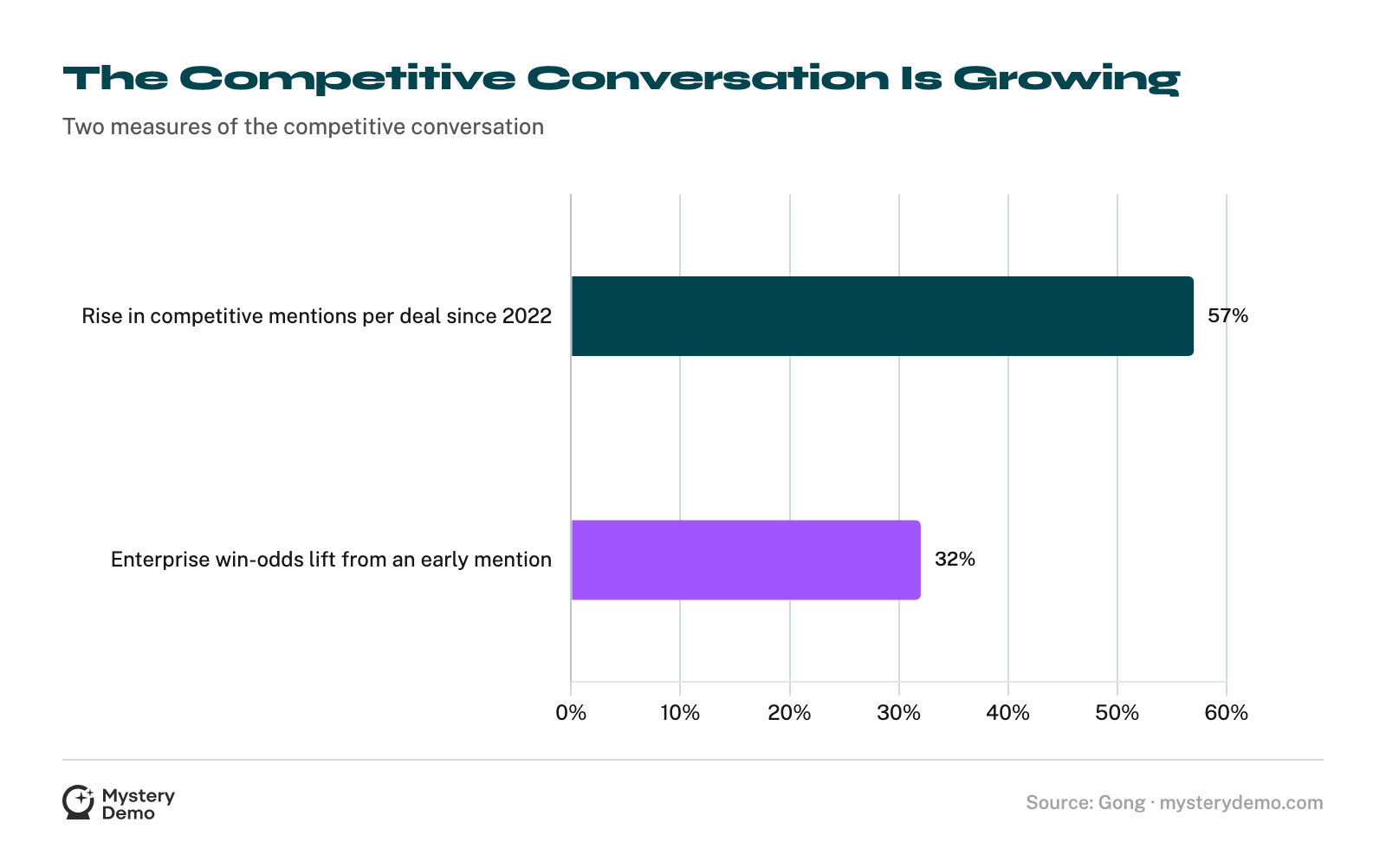
The 57% jump is the trend line under everything else here. Buyers are arriving with more alternatives, naming them more often, and expecting sellers to handle the comparison without blinking.
The enterprise cut matters too: even in the longest, most multi-vendor evaluations, an early comparison still tracks with better odds.
What Winning Sellers Do When Named
Sellers who win competitive deals and sellers who lose them both hear competitors come up. What separates them is what happens in the conversation next.
In early competitive deals, winning sellers covered positioning-related topics 58% more than the sellers who eventually lost4. On won deals, competitors are mentioned 5 to 6 times in discovery, versus 3 times on lost deals5.
Both numbers point the same way: winners talk about the competition more, and earlier. The losing pattern is avoidance, three mentions in discovery and a quick subject change.
The winning pattern is to surface the comparison, name it, and spend real time on positioning while the buyer is still forming the ranking. That is precisely the moment a competitor’s own reps reveal their playbook: which differentiators they trust, which they fumble, where they reach for a discount.

We hear how your competitors answer when a buyer says your name.
We book the seat. Two names go on the table, yours and theirs, and we bring back the script the rep leans on, the question they cannot answer cleanly, and the minute the price starts to move.
For the full teardown of how they position against you, see our competitor messaging comparison.
Want the timestamp where your name comes up on a competitor’s call, the line the rep reaches for, and how long it takes them to move on price? Talk to us and we’ll sit those calls for you. We begin with whoever keeps surfacing in your lost deals.
Frequently Asked Questions
How often do competitors get mentioned on B2B sales calls?
More than ever. The average number of competitive mentions per deal has risen 57% since 20223, and on won deals competitors come up 5 to 6 times in discovery versus 3 on lost deals5.
Does mentioning a competitor hurt or help the deal?
It depends entirely on timing. Raised early by the buyer, a competitor mention marks a deal 49% more likely to close1; raised late, close rates fall below deals with no competitor at all2.
What are the close rates when a competitor comes up early versus late?
Deals close at 32% when a competitor comes up early, 21.5% when one never comes up, and 20.4% when it surfaces late2.
Why does an early competitor mention help?
Because it signals a buyer who is comparing seriously, and sellers who engage the comparison win more. In new markets, raising competitors at the start of the cycle correlates with a 24% higher chance of closing than not discussing them at all4.
Why does a late competitor mention hurt?
Late, a competitor is usually being used as a bargaining chip, and the seller is defending rather than leading. Mid-to-late competitive deals close slightly below greenfield deals1, and in our own walk-throughs a discount usually follows.
Do buyers decide between competitors before talking to sales?
Largely, yes. 94% of buying groups rank their shortlist in order of preference before contacting any seller6.
Does the first vendor a buyer talks to usually win?
Among buyers who ranked their shortlist before seller contact, 84% went on to purchase from the first vendor they spoke with6.
Do early competitor mentions help on enterprise deals?
Yes. An early competitive mention raises the odds of winning an enterprise deal by 32% over never discussing the competition3.
What do sellers who win competitive deals do differently?
They engage the comparison instead of dodging it. Winning sellers covered positioning topics 58% more than the sellers who lost in early competitive deals4, and competitors come up more often on their won deals5.
How much sales-call data is behind these findings?
A lot. The core competitive-selling study analyzed 24,077 competitive deals and the conversations across them4, alongside conversation-intelligence research comparing discovery-call patterns on won versus lost deals5.
Should a rep bring up the competition first?
The data favors surfacing it early. In new markets, raising competitors at the start of the cycle correlates with a 24% higher chance of closing than not discussing them at all4. Late competitive discussion tracks the other way2.
What does a late competitor mention signal to a competitor-watcher?
That the deal has turned defensive. In our own walk-throughs, a rival’s name surfacing late in a competitor’s funnel usually precedes a discount, which is one of the clearest tells a mystery demo surfaces.
How do you find out how a competitor responds when named?
Someone has to be in the room. That means real time on their calendar under a genuine use case, then reading back what a buyer hears: which differentiators they trust, which ones they hurry past, and where the price finally moves.
References
- Gong Labs: How Competitor Mentions Influence B2B Sales (2016)
- Gong Labs: 55 Sales Tips and Techniques for Better Outcomes (2020)
- Gong Labs: The Best Sales Insights of 2024 (2025)
- Gong Labs: How to Master Competitive Selling and Win Every Time (2018)
- Speech Technology Magazine: Chorus.ai’s State of Conversation Intelligence (2019)
- 6sense: B2B Buyers Are Even Less of a Blank Slate Than We Thought (2025)
.png)


